PART 1
The silence in my kitchen after a house empties out does not feel peaceful. It feels heavy, like wet wool that takes days to dry. For three months, our home had smelled of rubbing alcohol, concentrated floor cleaner, and the sweet, terrible odor of failing organs. When Greg died in our bedroom on a Tuesday morning at three o’clock, the quiet came in behind the gurney and stayed.
Greg had fought esophageal cancer for fourteen months. By November, the doctors stopped offering clinical trials and started talking about comfort measures. I took family medical leave from my job at the county records office, rented a hospital bed for our downstairs den, and learned how to administer liquid morphine with a plastic dropper.
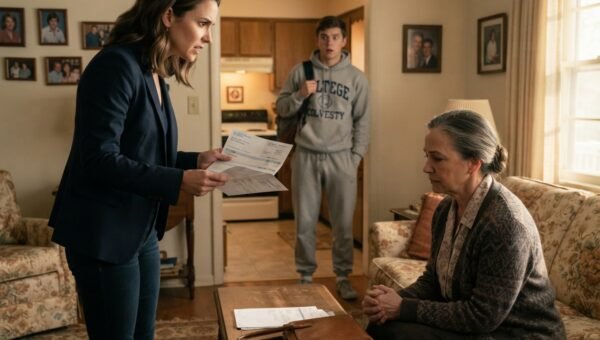
Greg’s mother, Evelyn, lived twenty minutes away in Westlake. During those final weeks, she came over almost every single day. She would park her Buick in the driveway, let herself in through the kitchen door, and sit in the armchair beside Greg. Sometimes she held his hand. Other times she complained about the heat, or asked me why the hospice nurses were not giving him solid food, or pointed out dust on the baseboards.
I never argued with her. I did not have the energy. My entire existence had shrunk down to Greg’s breathing, the turning schedule every two hours so his skin would not break down, and the crushing exhaustion that made my teeth ache.
If Evelyn wanted to sit there and criticize my housekeeping while her fifty-two-year-old son slowly slipped away, I let her. She was losing her boy. I told myself grief made people sharp.
Greg passed away on December 12.
The funeral was on a Saturday. It was cold and gray, the ground frozen solid at the cemetery. At the reception in the church hall, people lined up to hug me. But by the time we moved toward the coffee urns, I felt a strange chill in the room.
Greg’s younger sister, Brenda, stood near the coat rack with her arms crossed, refusing to look in my direction. When my brother-in-law Mark walked past me to get a cup of decaf, I reached out to touch his sleeve. He pulled his arm back as if I had burned him.
“Mark?” I said, my voice barely working. “Are you alright?”
“I don’t know how you look yourself in the mirror, Sarah,” he muttered under his breath, his jaw clenched tight. He walked away before I could answer.
By Sunday evening, my phone was silent. No casseroles arrived on Monday. When I texted Brenda to ask if she wanted Greg’s high school yearbooks, the message sat on read.
Three days later, my cousin Laura called me from Ohio. Laura has always been blunt, the kind of woman who refuses to dance around bad news.
“Sarah, what happened on Monday night before Greg died?” Laura asked without saying hello.
“What do you mean?” I sat down on the edge of the unmade bed, holding the phone against my ear with a shaking hand. “Greg was barely conscious. The hospice nurse came at four in the afternoon. I was with him all night.”
“Evelyn is telling the entire family that you locked her out,” Laura said, her tone dead serious. “She told Brenda, she told Mark, and she called your aunt Carol. She’s telling everyone that she drove over at midnight because she had a mother’s intuition that Greg was dying.
She said she pounded on the front door for twenty minutes, begged you through the glass to let her say goodbye to her son, and you stood in the window, looked right at her, and left the deadbolt turned.”
The air left my chest so fast I felt dizzy.
“Laura, that never happened,” I whispered. “I swear on my life that never happened. The door was unlocked until ten o’clock. After that, nobody knocked. Nobody rang the bell. I was sitting right beside Greg holding his hand. I never left that room.”
“Well, nobody believes that,” Laura said softly, and for the first time she sounded tired. “They’re saying you were cruel. Brenda told everyone you kept Evelyn away out of spite because of money.”
I had no strength to fight them. Grief does not make you angry at first; it makes you hollow. I could barely remember to eat toast or feed the cat. Defending myself against a mother who had just buried her son felt pointless. If his family wanted to hate me to make their pain easier to carry, I decided to let them. I shut my blinds, stopped answering the phone, and went through the motions of surviving.
Four months went by. March arrived with muddy lawns and gray rain.
I finally decided to cancel our outdoor security package. We had an old subscription service that stored cloud footage from the front porch camera, and with Greg gone, I needed to cut our monthly expenses to fit my single salary. The company sent an email warning me that after thirty days, all stored video archives from the past year would be permanently deleted.
On a rainy Thursday night, I sat down at the kitchen table with Greg’s old laptop and an external hard drive to download the saved family clips before the account closed.
I scrolled through months of mundane history. Greg carrying bags of mulch in July. The mail carrier dropping packages. Friends bringing soup.
Then my finger stopped on the timeline bar.
December 11. The night before Greg died.
There was an motion alert saved at 11:48 p.m.
My heart began to pound against my ribs. I clicked the small play button on the screen.
The black-and-white night vision camera showed our front walkway. Headlights swept across the shrubs as a sedan pulled up to the curb. Evelyn stepped out. She wore her dark winter coat with the fur collar and carried her purse over her forearm.
She walked up our three front steps and stopped squarely on the porch mat.
She did not reach for the brass knocker. She did not press the glowing doorbell button. She did not tap on the glass or peer through the sidelight.
Instead, Evelyn stood perfectly still under the porch light, reached into her coat pocket, and pulled out her cell phone. She tapped the screen, lifted the phone to her ear, and waited.
The porch camera had an audio receiver. Through the laptop speakers, I heard the faint rustle of her coat, the distant sound of wind in the bare oak tree, and then her clear, steady voice.
“He’s still alive,” Evelyn said into the phone. “Don’t file anything yet.”
PART 2
I stared at the laptop screen in the dark kitchen, the blue light reflecting off my glasses. My hand on the trackpad was trembling so hard the cursor jumped across the display.
I replayed the clip. Ten seconds. Thirty seconds. A full minute.
Evelyn stood on the porch for exactly one minute and forty-two seconds. She spoke two sentences into the phone, listened for another thirty seconds while nodding, and then ended the call. She slipped the phone back into her coat pocket, turned around without ever laying a finger on my front door, and walked back down the sidewalk toward her car.
There had been no pounding. No crying. No desperate mother begging through the glass to say goodbye to her firstborn child.
She had stood on my porch at midnight, checked to see that the lights were still on in the downstairs den, made a phone call, and left.
The next morning, I took the laptop and the external hard drive straight to Dan Vance. Dan was an estate attorney in town who had handled my father’s probate years ago and had helped Greg and me set up our basic wills when Greg was first diagnosed.
Dan closed the door to his office, sat behind his oak desk, and watched the video three times in complete silence.
“She lied to everyone,” I said, my voice cracking. “She turned his entire family against me with that story. But Dan, listen to what she said. Why would she tell someone not to file anything yet?”
Dan rubbed his chin, looking at the freeze-frame of Evelyn holding the phone to her ear.
“Sarah,” Dan said carefully, “who was Greg’s life insurance through?”
“His old union policy,” I answered immediately. “Through the electrical workers. It was a standard group policy, two hundred and fifty thousand dollars. We set it up years ago when we bought the house. I’m the primary beneficiary. I haven’t even filed the claim yet because the death certificates took nearly six weeks to arrive from the county.”
Dan did not answer right away. He opened a manila folder on his desk and pulled out a clean pad of paper.
“Evelyn worked as an office administrator for an independent broker down on 4th Street for twenty years, didn’t she?” he asked.
“Yes. She retired three years ago.”
Dan picked up his desk phone. “Wait here.”
He stepped out of the office to make a call. I sat in the leather chair, looking at the framed diplomas on the wall, listening to the muffled hum of the copy machine in the hallway. Fifteen minutes later, Dan walked back in and shut the door firmly behind him. His face was gray.
“I just spoke with a contact at the regional claims office for the union’s underwriter,” Dan said, leaning forward on his desk. “Sarah, an electronic claim was submitted against Greg’s policy on December 11 at 11:52 p.m.”
I stared at him. “What?”
“Four hours before Greg actually died,” Dan said. “The online portal logged an expedited death benefit application. But that’s not the worst of it. The underwriter flagged the file for internal audit because two weeks before Greg passed, on November 28, a change-of-beneficiary form was uploaded to their system.”
“A change of beneficiary?” The room felt like it was spinning. “Greg could barely hold a pen in November. He was sleeping twenty hours a day.”
“The form removed you as the primary beneficiary,” Dan said, reading from his notes. “It designated Evelyn Vance as the primary beneficiary, and Brenda Vance as the contingent. It had Greg’s electronic signature, along with a scanned notary stamp.”
“That’s fraud,” I breathed. “Greg never signed that. He would never take care of Evelyn and leave me with our mortgage. We talked about this. That policy was supposed to pay off the house so I wouldn’t lose it.”
“The claim submitted at 11:52 p.m. was rejected by the automated system,” Dan explained. “Why? Because whoever submitted it entered the time of death as December 11 at 11:30 p.m., but they failed to attach a certified death certificate or a doctor’s declaration. When a death claim is submitted without documentation, it immediately gets kicked to a human examiner. And when the examiner looked at it a week later, they saw that Greg didn’t actually pass until December 12 at 3:15 a.m., according to the vital records registry.”
The pieces fell together with a sickening crunch.
Evelyn had not driven to my house out of mother’s intuition. She had gone to my house to verify whether Greg had died yet. She saw the den lights, realized he was still breathing, and called whoever was sitting at a computer ready to hit ‘submit’ on the insurer’s portal.
“Don’t file anything yet,” she had said.
She had been talking to someone who had the claim queued up on a screen. And that person had panicked or miscommunicated, hitting the submit button just four minutes later anyway, creating a digital paper trail that exposed the entire scheme.
PART 3
Dan contacted the insurance company’s special investigations unit that afternoon. When an underwriter discovers a forged beneficiary change alongside a premature death claim, they do not treat it as a family squabble. They treat it as felony insurance fraud.
Two weeks later, Dan received the digital audit trail from the carrier.
The IP address used to upload the forged change-of-beneficiary form on November 28 did not come from my house. It came from Brenda’s apartment in Fairview. The notary stamp belonged to a woman named Carla Riggs, a former coworker of Evelyn’s who had retired from the same brokerage firm.
Dan called a meeting in his conference room. He invited Evelyn, Brenda, and Mark. He told them it was a mandatory estate distribution conference regarding Greg’s personal assets.
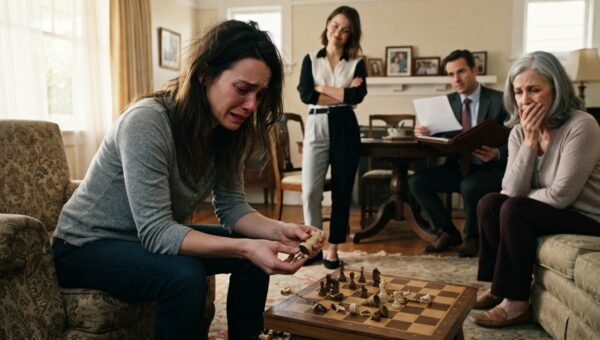
They showed up on a Tuesday morning. Evelyn wore a neat navy pantsuit with her silver hair freshly styled. Brenda sat next to her, glaring at me with the same cold, self-righteous anger she had worn at the funeral. Mark sat at the end of the table, staring at his hands, looking uncomfortable.
I sat across from them, next to Dan. Between us on the polished mahogany table was a flat computer monitor and a manila folder two inches thick.
“I don’t know why we’re here,” Brenda snapped before Dan could even open his mouth. “Sarah made it perfectly clear how she felt about this family when she locked Mama out in the freezing cold while Greg was dying. If there are things of Greg’s to divide, they should come to us without her sitting in the room.”
Evelyn reached over, patted Brenda’s hand, and pulled a lace handkerchief from her sleeve. “It’s alright, Brenda. I’ve forgiven her in my heart. God knows what she did.”
I felt no anger looking at her. Only a cold, crystalline calm that surprised me.
“Evelyn,” Dan said quietly, “we aren’t here to discuss Greg’s furniture.”
Dan turned the computer monitor toward them. He pressed the spacebar.
The porch video played.
The room was utterly silent except for the faint sound of the wind through the laptop speakers, and then Evelyn’s voice, loud and unmistakable:
*”He’s still alive. Don’t file anything yet.”*
Brenda’s mouth opened slightly. The color drained from her face so fast she looked ill. Mark slowly lifted his head from his hands and looked directly at his mother.
Evelyn did not move. She stared at the screen, her eyes narrowing into tiny slits.
“You never knocked on the door, Evelyn,” I said, keeping my voice level and quiet. “You never touched the handle. You stood on my porch for ninety seconds, made a phone call, and drove away. And then you told Greg’s entire family that I locked you out so they would hate me.”
“I… I was confused,” Evelyn stammered, her voice suddenly thin. “It was dark. I thought the door was locked.”
“You didn’t touch the door,” Dan interrupted, his voice dropping into the stern, authoritative tone of a seasoned trial lawyer. “And you weren’t confused. You were checking to see if Greg had expired so you could collect two hundred and fifty thousand dollars.”
Dan opened the manila folder and slid four sheets of paper across the table.
“This is the digital audit from Guardian Life,” Dan said, tapping the documents. “On November 28, a change-of-beneficiary form was uploaded from Brenda’s home internet connection. It bore a forged signature for Greg Vance and an invalid notary stamp from Carla Riggs. On December 11 at 11:52 p.m., four minutes after this video was recorded, Brenda logged into the portal and submitted a claim stating Greg had died at 11:30.”
Mark shoved his chair back from the table. He stood up, looking down at his mother and sister with absolute horror.
“What did you do?” Mark whispered, his voice cracking. “What did you two do?”
“Mark, be quiet!” Brenda hissed, her hands shaking violently as she grabbed her purse. “We did it for the family! Sarah was going to get everything! Greg worked thirty years, and she was going to take every penny!”
“Sarah was his wife!” Mark shouted, slamming his hand onto the table. “She wiped his chin! She changed his sheets every morning while you sat there complaining! You told me she locked Mama out! I didn’t speak to Sarah at my own brother’s funeral because of what you told me!”
Evelyn sat rigid, her jaw clenched, refusing to look at Mark or Dan. Her eyes were fixed on the papers.
“Guardian Life’s fraud division has already completed its preliminary report,” Dan told them calmly. “Because the claim crossed state lines through an electronic portal, this is wire fraud. The underwriter has prepared a referral for the state attorney general’s office. Carla Riggs has already been interviewed by an investigator. She admitted she never saw Greg sign that paper.”
Brenda began to sob, ugly, choking sounds into her hands. “Mama said it was fine. Mama said Greg promised her the money before he got sick.”
“I never promised anything,” a voice inside me wanted to scream, but I kept still.
Dan leaned across the table. “Here is how this ends today. Brenda, you will sign a formal, notarized waiver of any and all claims against Greg’s estate, his personal property, and his insurance policies. Evelyn, you will do the exact same. Furthermore, Evelyn, you will sign a retraction admitting that you fabricated the story about Sarah locking you out of the house, and you will allow Sarah to share that document with the family.”
“And if we don’t?” Evelyn said, her voice dropping all pretense of grief, cold as slate.
“If you don’t,” Dan said, “I hand this file to Detective Miller at the county financial crimes unit by two o’clock this afternoon. Carla Riggs is facing the loss of her notary license and criminal charges. She will not protect you. At your age, Evelyn, and with Brenda’s employment at the school district, I suggest you take the waiver.”
ENDING
Brenda signed the papers twenty minutes later, her tears smearing the ink near the signature line. Evelyn signed with a steady, furious hand, pressing down so hard the ballpoint pen nearly tore through the legal bond. She did not look at me once. When she finished, she stood up, gathered her coat, and walked out of the building without saying a word to her daughter or her remaining son.
Mark stayed behind.
He sat in the conference room chair for ten minutes after they left, his face buried in his palms, his shoulders shaking.
“Sarah,” he said when he finally looked up, his eyes bloodshot and swollen. “I don’t even know what to say. I believed them. I treated you like garbage while you were burying my brother.”
“You didn’t know, Mark,” I said. “They used your grief against you.”
I did not press criminal charges against Brenda or Evelyn. Dan advised me that pursuing the prosecution would take two years of court dates, depositions, and public exposure that would drag Greg’s memory through the mud. The insurance company permanently barred their claims, reinstated my original beneficiary status, and paid out the full policy to me three weeks later.
I used the money to pay off the remaining balance on our mortgage, exactly as Greg and I had planned sitting at our kitchen table three years earlier.
Mark took a copy of the video and the signed retraction to the rest of the family. He played it for Brenda’s husband, for his aunts, and for our cousins. The silence that followed was total. Brenda resigned from her administrative job at the middle school two months later when rumors began circulating through the district office, and she eventually moved forty miles south.
Evelyn stopped going to her church. People in town have long memories, and Carla Riggs had not kept quiet about why the state had revoked her notary commission.
Last week, I finally finished packing Greg’s clothes to donate to the veterans’ shelter downtown. I found his winter coat hanging in the hall closet, the one he wore when we took the dog for walks through the woods behind our house.
I took the coat outside onto the front porch. It was an April afternoon, warm enough that the daffodils along the walkway were starting to bloom.
I looked at the spot on the doormat where Evelyn had stood that night with her phone in her hand, calculating the minutes until her son’s heart stopped beating.
I had spent months carrying the shame of a cruelty I never committed, letting their lies poison my grief. But standing there in the sunlight, listening to the birds in the oak tree, I realized something important.
They took my husband’s final days and tried to turn them into an audition for an inheritance. But they didn’t get the money, they didn’t get the house, and they didn’t get to keep their lie.
I locked the front door behind me, walked down the steps, and put Greg’s coat in the back of my car. For the first time in five months, the silence around me didn’t feel heavy anymore. It just felt like my own life, waiting for me to live it.