PART 1
The little boy was maybe four years old, wearing red canvas sneakers and a gray sweatshirt with dinosaurs across the front. He came tearing across the wood chips near the swings at Miller Park, straight toward the park bench where David and I were sitting with our paper cups of coffee.
“Grandpa!” the boy yelled.
He did not hesitate. He did not slow down. He threw his small arms right around my husband’s neck.
David did not pull back. He dropped his cup into the wood chips, dropped to both knees in the dirt, and wrapped both arms around that child like he had done it a hundred times before. For three or four seconds, my husband held him against his chest with his eyes squeezed shut.
Then David opened his eyes and saw me staring at him.
His arms went stiff. He let go of the boy so fast the child nearly stumbled backward onto the mulch. David scrambled up, dusting his jeans with hands that were visibly shaking.
“He confused me with someone else,” David said. His voice came out thin and tight, completely unnatural. “Kids do that all the time. You know how kids are, Brenda.”
“I did not,” the little boy said, looking up at David with huge, serious brown eyes. “You’re Grandpa Dave. Look.”
The child reached out his small hand and pointed directly at David’s right thumb.
There was a thick, jagged white scar running from the knuckle down into the nail bed, the result of a table saw slip in our garage twelve years ago.
“The saw bite,” the boy said clearly. “In the wood room behind the house with the yellow bird feeder.”
David had built that cedar workshop behind our house seven years ago. He had painted the bird feeder bright yellow three summers back. Nobody called it the wood room except someone who had spent real time inside it.
Before I could get a breath into my lungs, a woman came jogging down the paved path from the public restrooms. She was wearing faded scrubs and sneakers, her hair pulled back into a messy clip.
“Leo!” she called out, breathless. “Leo, what did I tell you about running off?”
She reached us, grabbed the boy’s hand, and then looked up at David. The scolding died in her throat.
I recognized her instantly. It had been four years, but you do not forget the face of the woman who spent fourteen straight nights in the surgical ICU turning your twenty-two-year-old son every two hours so his lungs would not fill with fluid. Her name was Claire. She had been our son Toby’s primary trauma nurse after his motorcycle crash on Route 9.
“Claire?” I said.
Claire looked from David to me, and all the color left her face. She blinked several times, stepping half an inch behind her son.
“Brenda?” she whispered.
“Why does your son know my husband?” I asked. “Why does he know the workshop behind our house?”
Claire looked straight at David. She was not angry yet, but she was stunned, her jaw slightly slack.
“What is she doing here?” Claire asked him. Her voice was steady, but her fingers gripped Leo’s shoulder hard. “You told me she moved away to Arizona two years ago. You said the divorce was finalized.”
David stepped between us, raising both palms like he was trying to stop traffic. “Claire, stop. Brenda, listen to me. This isn’t what you think.”
“Grandpa Dave makes the wooden ducks,” little Leo said into the quiet, tugging his mother’s scrub pants. “The ones with wheels.”
That was when the gate near the swings clicked open.
Footsteps came crunching over the wood chips. Heavy, uneven footsteps.
“Mom?” a voice called out.
I turned around.
Walking toward us was Toby. He had his hands in the pockets of his dark green canvas coat, leaning slightly to the left the way he had ever since the orthopedic surgeon put two titanium rods through his femur. He stopped about ten feet away from the bench, looking at Claire, looking at the little boy, and then looking directly at his father.
Toby did not look surprised at all.
PART 2
Toby stood there on his bad leg, looking between David and Claire. He did not look at me until he had taken a full measure of the panic on his father’s face.
“You brought her here?” Toby asked David.
“We just came for coffee, Toby,” David said, his voice dropping into that pleading, hurried tone he used whenever our bank account was overdrawn. “We were just sitting on the bench. It was an accident.”
“An accident,” Claire repeated. She pulled Leo closer to her side. Her voice had changed from confusion to absolute fury. “You told me she was in Scottsdale. You told me she couldn’t handle Toby’s recovery, that she took her half of the house and left you two with the medical bills.”
The air went completely out of me.
Four years ago, when Toby spent three months at St. Jude’s after that car pulled out in front of his bike, I had cashed out my entire 401(k) from twenty-four years of bookkeeping at the county water district. It was $84,650 after the early withdrawal penalties and taxes. Every single dollar of it went into our joint account to pay the flight-for-life transport and the out-of-network surgical team.
I had slept on the vinyl recliner in Toby’s hospital room until my lower back felt permanently bruised. When Toby finally came home, I washed his surgical drains. I changed his dressings twice a day. I cooked his meals and drove him to physical therapy three mornings a week for eight months until he told me he needed his independence, rented an apartment twenty minutes away across town, and started pulling back from Sunday dinners.
“I gave you eighty-four thousand dollars, David,” I said. I did not yell. My voice sounded flat and dry, like old paper. “I never left that house. I’ve lived on Elm Street for twenty-nine years.”
Claire stared at me. “He brought Toby to my apartment after the discharge. Toby needed weekly wound care that insurance stopped approving. David told me you took off.”
“Dad,” Toby interrupted, his jaw set tight. “Don’t do this here. Let’s go.”
“No,” I said. I looked directly at my son. “No, Toby. You are twenty-six years old. Look at me.”
Toby looked down at the wood chips. His boots scraped the cedar shavings into a little pile.
“Whose boy is that, Toby?” I asked.
The silence lasted so long that a couple walking a golden retriever on the main path glanced over at us.
“He’s mine, Mom,” Toby said quietly.
Claire did not deny it. She knelt down beside Leo, adjusting the boy’s dinosaur sweatshirt, but her hands were trembling. “Toby and I got close while he was recovering,” Claire said, looking up at me with dark circles under her eyes. “He was in a bad place. I was a single mom working night shifts, trying to keep up. When I found out I was pregnant, Toby panicked. He said he had no money, no career left, nothing. But David came to me.”
“David came to you?” I asked.
“David said he would handle everything,” Claire whispered. “He told me he had an inheritance from his uncle. He said Toby wasn’t ready to be a full-time father, but that he wanted to be a grandfather. David’s been coming by my house every other Tuesday for three years. He watches Leo while I sleep before night shifts. He brings him to his workshop on Saturday mornings when you were supposedly working your volunteer shifts at the shelter.”
Every Saturday morning for three years, I had gone to the community kitchen from eight until noon, believing David was at home resting his bad knee.
“Where did the money come from, David?” I asked.
David didn’t answer. He was staring at the ground, his shoulders slumped inside his windbreaker.
“He pays my rent,” Claire said, her voice cracking. “Fifteen hundred dollars a month, in cash. In plain bank envelopes. He told me it was family money, Brenda. He swore to God you abandoned them.”
PART 3
I turned and walked away from the playground.
I did not run. I did not cry. I walked down the paved path, got into my Subaru, and drove the four miles back to our house on Elm Street.
David arrived ten minutes later in his pickup. The tires crunched hard on the gravel driveway. He came through the back kitchen door, out of breath, smelling of cold air and old coffee.
“Brenda, please,” he started, reaching for my arm. “You have to let me explain before you do something crazy.”
“Don’t touch me,” I said.
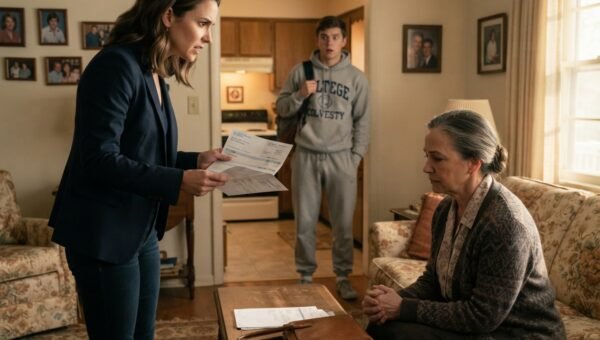
I was standing in our home office with the filing cabinet open. I had already pulled the yellow folders containing our joint savings statements, our tax filings, and the equity line of credit we had taken out five years ago to replace the roof.
“Toby was terrified,” David said, leaning against the doorframe. “He was twenty-three when Claire got pregnant. He had no job, a shattered leg, and he was taking pain pills just to walk down the hall. If Claire took him to court for child support, he would have ended up in jail or dead. He couldn’t handle it, Brenda. I had to protect our son.”
“You protected him by telling that girl I abandoned him?” I pulled out the home equity statements. “You protected him by erasing me?”
“You would have forced him to grow up too fast,” David yelled, his face turning mottled red. “You’re so practical, Brenda! You’re always about budgets and rules and doing things the right way. You would have dragged him to court, made him get a job he couldn’t do, made him face everyone in town. Claire needed help, and Toby needed time.”
“Where did the cash come from, David?”
I slapped the home equity papers down onto the desk between us.
The last balance I had checked six months ago was $12,000, left over from the roof repairs. But as I flipped to the most recent statement from First National Bank, dated two weeks ago, the printed balance at the bottom of the page was $66,000.
David had drawn down fifty-four thousand dollars against our house.
Fifteen hundred dollars a month. Three years. Thirty-six months. That was exactly fifty-four thousand dollars.
“You borrowed against our home,” I said. “My name is on this deed. My name is on this loan.”
“We can pay it back,” he pleaded. “The interest is low. Toby is working again now, at the lumber yard. He was going to start pitching in next month. I was going to tell you once things were settled.”
“He’s four years old, David,” I said. “Leo is four years old. When were things going to be settled? When he graduated high school?”
The front door opened.
Toby walked into the house without knocking. He had driven over from the park in his beat-up Civic. He looked pale, leaning against the wall in the hallway, his coat still zipped up to his chin.
“Mom,” Toby said.
“Did you know he told Claire I left you?” I asked him.
Toby looked at David, then looked at the floor. “Not at first,” he mumbled. “At first, Dad just said he was taking care of Claire so she wouldn’t file paperwork with the state. Then last year, Claire asked me why you never sent a birthday card to Leo. That’s when I found out what Dad told her.”
“And you let her believe it,” I said.
“I was ashamed,” Toby said, his voice breaking. A tear ran down his cheek, catching in the scruff of his beard. “I couldn’t even pay my own car insurance, Mom. Dad was fixing it. He kept telling me he had it handled, that you didn’t need the stress after everything you did during the hospital stay. He said you’d had a nervous breakdown after my crash and couldn’t handle another crisis.”
David flinched. He didn’t look at either of us.
“Get your things, David,” I said.
“Brenda, this is my house too,” David said, trying to find some gravel in his voice. “I built that workshop with my own hands.”
“You forged my initials on the equity draw request,” I said, pointing my finger at the third page of the bank statement where a crude copy of my signature sat right next to his. “I worked at the water district for twenty-four years. I know fraud when I see it. You pack two bags and you leave right now, or I walk into the police station on 4th Street before five o’clock.”
ENDING
David packed his clothes into two plastic storage tubs and put them in the bed of his truck. He left before three that afternoon. He went to stay at his brother’s place out near the reservoir.
The house was completely silent when he drove away.
I sat at the kitchen table with the papers spread out around me. Fifty-four thousand dollars on the equity line. My 401(k) completely gone from Toby’s hospital bills. Twenty-nine years of marriage, and my husband had spent the last three building a secret life on Tuesday afternoons, playing grandpa with wooden toys he carved in our garage while telling a young mother I had walked out on my own flesh and blood.
Two days later, on Monday morning, I drove over to Claire’s apartment complex on Maple Avenue.
I knocked on the door. When Claire opened it, she looked tired, her hair pulled back in that same clip, holding a dish towel. When she saw me, her body stiffened, preparing for a fight.
“I brought something,” I said.
I handed her an envelope. Inside were copies of my bank withdrawals from the month Toby was in the hospital, showing the $84,650 transfer. Beside it was a copy of my driver’s license showing my Elm Street address, and my utility bills from every single month of the last four years.
Claire looked at the papers. She stood in the doorway and read them twice. When she looked up, her eyes were wet.
“He told me you hated children,” she whispered. “He told me you told Toby you wished he had died on that bike so you wouldn’t have to look at him.”
A sharp, violent pain hit the center of my chest, but I kept my feet planted on the concrete landing.
“David is a liar,” I said. “Toby is weak, and he hid behind his father. But that boy didn’t do anything wrong.”
Claire looked back over her shoulder into the living room. Little Leo was sitting on the carpet, rolling a small wooden duck across the floorboards. The duck was unpainted pine, with four little wheels held on by brass screws.
“Toby has to pay child support,” I told her. “I’m not protecting him. If you file the paperwork with the county, I will give you the name of Toby’s employer and the account information for his payroll. I will not stop you.”
Claire nodded slowly. “And David?”
“My lawyer is filing the divorce petition on Friday,” I said. “We’re selling the house. The equity line will come out of David’s half of the proceeds, not mine. The bank’s fraud investigator already has the signature sheets.”
Claire looked down at the dish towel in her hands. “David loved that boy, Brenda. That’s the sick part. He really loved him.”
“David loved being the savior,” I said. “He didn’t want the work of being a husband, and he didn’t want the work of teaching our son how to be a man.”
She stepped back from the door. “Do you want to come in?”
I looked past her shoulder at the little boy on the rug. Leo had David’s chin and Toby’s wide, dark eyes. He was my grandson. He had my blood in his veins, but right now, looking at him felt like looking at a car wreck I hadn’t survived.
“Not today, Claire,” I said gently. “Give me some time.”
I walked down the stairs and got back into my car.
When I got home to Elm Street, I walked out back to the cedar workshop. The padlock was hanging open. I walked inside, past the table saw, past the smell of cedar shavings and motor oil.
Sitting on the workbench was another little pine duck, fully sanded, with two small wooden wheels waiting beside the drill press.
I picked up the little wooden duck, carried it out to the metal trash can by the garage, dropped it inside, and let the lid slam shut.