I was tired enough to let a stranger put something heavy in my coat while I was seven months pregnant, and I nearly threw it away before I found out why.
I’d just finished a double shift as a hospital billing coordinator. My feet had that hot, swollen feeling where even the seams in my socks bothered me, and I was trying to stand without leaning on the yellow pole too hard.
The Route 14 bus was crowded. I was thinking about rent, the baby, and whether David had found any paid work that week.
Three months earlier, a fire had destroyed the shared garage where David ran his finish carpentry business and kept his tools. We’d used most of our savings replacing what we could. He was picking up small jobs, but the money came in unevenly, and our apartment rent didn’t care.
At the Oakridge stop, an older woman got on with a cane and a canvas tote. People looked at their phones or out the windows. I waited a second, hoping someone else would move. Nobody did. So I stood and offered her my seat.
“Thank you,” she said.
She looked right at me as she sat down. Not a quick glance. She kept studying my face, especially my eyes, and it made me self-conscious. I wondered if I had something on my cheek. I looked away, then caught her looking again.
At her stop, she pushed herself up with the cane. As she passed me, she slipped something into my coat pocket. It landed with a solid thump against my hip.
I turned around, but she was already stepping off.
“What was that?” I called.
“Saturday,” she said, without looking back.
The bus pulled away before I could ask anything else.
I took the object out. It was a heavy brass key tied to a worn leather luggage tag. The tag had an Oakridge Avenue address stamped into it, and a folded card was tucked under the leather loop. I stood in the aisle reading it while people squeezed past me.
“You’re too pregnant to be standing on a bus, and too stubborn to ask for help. Come see the house Saturday at ten. Don’t argue.”
That was the note. No name. No explanation.
I was annoyed, honestly. I’d given her a seat, not asked to be assessed.
And she’d put a stranger’s key in my pocket like she had the right to decide what I needed. The nerve of it was almost funny, except my hand kept closing around the key.
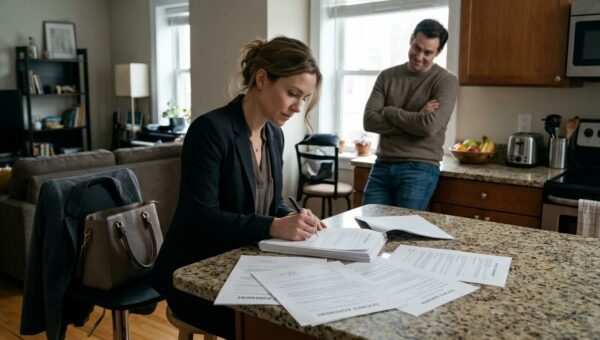
At home, David was at the kitchen table with a pencil behind his ear, sorting receipts from the fire cleanup. He’d been doing that most nights, trying to work out what we could afford without saying the answer out loud.
I set the key beside his mug.
“A woman on the bus gave me this,” I said. “She told me to look at a house.”
He picked it up and turned it over. “You know her?”
“No.”
“Did she say who she was?”
“No. Just Saturday at ten.”
He read the note. His mouth tightened a little at the words about asking for help. I knew why. Since the fire, every offer of help had felt like another reminder that his business was gone.
He’d turned down money from his brother because he didn’t want to owe anybody.
“Could be a prank,” he said.
“Could be.”
We both looked at the key again. The leather tag had a faint sticker on its back, so worn I had to rub it with my thumb to read it. Miller’s Pond Boat Club.
I recognized the name, but not from anywhere I’d been. The old brass key blank looked like the kind used on older houses, not the newer locks in our apartment building. The address was in Oakridge, a neighborhood of old homes that I’d only passed through on the bus.
David said we shouldn’t go until we knew who the woman was. I agreed, though I didn’t want to admit that I was already picturing a baby’s room with a door that closed.
I called my mother.
“Do you remember a woman named Evelyn Vance?” I asked. “Or Miller’s Pond Boat Club?”
There was a pause. Then Mom asked why.
I told her about the bus, the key and the note. I described the woman’s age, her cane, the canvas tote. Mom went quiet again, and I could hear the TV in the background at her house.
“Martha had a friend named Evelyn,” she said. “They knew each other through Miller’s Pond.”
My grandmother Martha had died when I was in my twenties. I remembered her hands and the way she kept a tin of peppermints in her purse. I also remembered her eyes, brown with little amber flecks near the center. I have them too.
Mom said Evelyn had a young son who went into the pond when he was about six. Martha pulled him out. The families lost touch after Martha moved away, and as the years went by, nobody seemed to know how to find anybody.
“I think she said the boy was named Paul,” Mom added. “He’s alive. I remember hearing he moved west.”
That was the first time the key felt less like a strange stunt and more like something I needed to follow up on.
I told David what Mom had said. He rubbed his forehead and said the connection was real, but that didn’t mean the house was safe to accept. It was fair to worry. We were both tired of being one unexpected bill away from trouble, and the idea of a stranger offering us a home was almost too much to believe.
“We’ll go,” I said. “We’ll look. We don’t have to agree to anything.”
He nodded, but not right away.
Saturday morning, we drove to Oakridge. The house was a few blocks off the main road, with old trees and front porches close to the sidewalk. The address on the tag matched a small craftsman house with peeling paint along one porch rail. Out back, I could see a detached workshop.
David noticed it too. He stopped on the walk and looked at the building longer than he looked at the house.
A woman opened the front door before we knocked. She had the same cane and canvas tote. Up close, she seemed smaller than she had on the bus, but her eyes were sharp.
“Clara?” she asked.
“Yes.”
“Evelyn Vance,” she said. “Come in. You brought the key.”
I held it up. “You put this in my pocket.”
“I did.”
“You could’ve just told me your name.”
“I could have,” she said. “I didn’t.”
There wasn’t much apology in her voice, but it didn’t feel mean. It sounded like a person who’d made up her mind and didn’t expect to be talked out of it.
She led us into the parlor and took a photo album from a shelf. One picture showed my grandmother, much younger, standing near the water with a little boy wrapped in a towel. Evelyn tapped Martha’s face.
“That’s the first time I saw those eyes,” she said. “On the bus, you looked up at me and I knew.”
I looked at the picture. The eyes were clear even in the old photo. Evelyn told us Martha had pulled her son Paul out of Miller’s Pond forty years earlier. Evelyn had been getting help from another parent when it happened, and by the time she could think straight, Martha had gone. They exchanged letters for a while, then life got busy and the letters stopped. Evelyn had carried the memory anyway.
“I wanted to thank her properly,” she said. “I never got the chance.”
I didn’t know what to say. I’d heard the story growing up, but I’d never imagined it had stayed with someone all that time.
Evelyn was moving to Oregon to be near Paul, now grown with a family of his own. She didn’t want to sell her house to developers, and she didn’t want it sitting empty. The workshop had been her late husband’s, she said. She’d kept it up, though not every bit of woodwork had held up as well as she wanted.
She’d been looking for the right people to take the place over. Not rich people. Not people who’d gut it and flip it. When she saw me give up my seat, she said, she saw Martha’s eyes and the same quiet habit of noticing somebody else.
“That’s a lot to put on one bus ride,” I said.
“It is,” she answered. “I know.”
Then she told us what she wanted to offer. We could live in the house and pay a small monthly caretaker fee. David could use the workshop and take care of repairs. She’d have an attorney draw up a lease with an option to buy, with fair payments and clear terms. It wasn’t a no-strings gift, but it was close enough that David shifted in his chair.
“I can’t just take a house,” he said.
Evelyn looked at him. “I’m not asking you to take it for nothing.”
“I still don’t want anybody thinking we got handed something.”
That was the part I understood most. David had spent months trying to build his work back from nothing, and he didn’t want our first real break to feel like pity. But we also had a baby coming, and the apartment renewal was due. I could feel the question of where we’d live sitting between us like another unpaid bill.
I said we’d pay a fair amount. We’d have a lawyer review the agreement. David would repair the porch and the house’s woodwork in exchange for using the workshop, and the work would be written into the contract, not left to anyone’s memory.
Evelyn listened. Then she said that sounded fair.
David asked if we could bring our own attorney. Evelyn said yes. She wanted everything clear, too.
Two weeks later, we met with a local real estate attorney and signed a caretaker lease-to-own agreement. We canceled our apartment renewal. The monthly payment was manageable, the purchase terms were written down, and David’s repair work was part of the deal. No handshake promises. No guessing what anybody meant.
Evelyn moved to Oregon before the baby came. She called now and then, and I wrote back when I had a quiet minute. David started in the workshop as soon as we had the keys. At first, the saw noise startled me, then it became part of the house.
I still think about how I nearly threw the key away. I was used to help coming with a price I couldn’t see yet. This time, the price was plain, the work was fair, and we got to make a home without pretending we hadn’t needed one.
One evening, two weeks after we moved in, I stood at the nursery window with one hand on my belly and the brass key in the other. David was working out back. His saw hummed through the open window, and the baby kicked against my palm.
The key was warm from my hand, and the tag still said, “Don’t argue.”