PART 1
The smell of my mother’s rosewater perfume had lingered in the hallway closet for over a year after she passed away, a ghost scent that made my chest tighten every time I reached for my winter coat. I was fourteen years old when she lost her battle with ovarian cancer, an age where the world already felt too loud and fragile to bear. Six months after the funeral, while the dirt on her grave was still fresh and the sympathy casseroles had long stopped coming, my father announced he was marrying Brenda.
Brenda was not just any neighbor; she was my mother’s dearest confidante, the woman who had brought over chicken soup every Tuesday, held my mother’s hand during chemotherapy sessions, and sat in our kitchen weeping into her coffee cup. To my teenage mind, the betrayal felt absolute, grotesque, and unforgivable. On the humid evening my father gathered me in the living room to break the news, I screamed until my throat bled. I told my stepmom straight to her face with venom in my voice that she was a vulture who had stolen my mother’s life, her home, and her place at the table.
From that day on, I built an iron wall around myself. I refused to eat meals cooked by Brenda, ignored her gentle birthday cards tucked into clumsy envelopes, and spoke to my father only when absolute necessity demanded it. When I left for college at eighteen, I packed my bags, cut off financial support, and moved four hundred miles away, vowing never to return to that house of shadows.
Years slipped by in a blur of student loans, grueling nursing shifts, and quiet holidays spent alone in a cramped studio apartment. I built a life entirely independent of them, fueled by a stubborn pride that kept my old wounds fresh. When I met Mark, a kind and steady high school English teacher with a quiet laugh, and we finally set a date for our wedding, the question of whether to invite my father hung over us like a thundercloud. After much agonizing, I sent a formal invitation out of sheer obligation, never expecting him to show up.
Yet, two weeks before the ceremony, as I was untangling a string of fairy lights in our small living room, my phone buzzed with an unfamiliar local number. It was a hospice nurse calling from a hospital three miles from my childhood home. My father was not coming to the wedding because he was dying of rapid-onset pulmonary fibrosis, his lungs giving out after decades of quiet wear.
Mark drove me through the night, our car cutting through the rain-slicked interstate highways until we reached the sterile, fluorescent-lit hospital room just before dawn. My father looked like a shrunken shell of the imposing man I remembered, his skin gray and papery against the white pillows. Sitting beside his bed in a worn floral armchair was Brenda, her hair now completely white, her eyes rimmed with deep purple exhaustion from keeping a round-the-clock vigil. When I walked through the door, she stood up slowly, her knees trembling, and looked at me with a mixture of profound sorrow and long-repressed terror.
PART 2
My father passed away quietly the following afternoon, his breathing slowing down until it simply stopped while Brenda held his right hand and I stood rigidly near the foot of the bed, my fingers dug into the metal bed frame. The funeral was a muted, somber affair attended by a handful of elderly neighbors who murmured polite condolences while I kept my distance from Brenda, still encased in the protective armor of my childhood resentment.
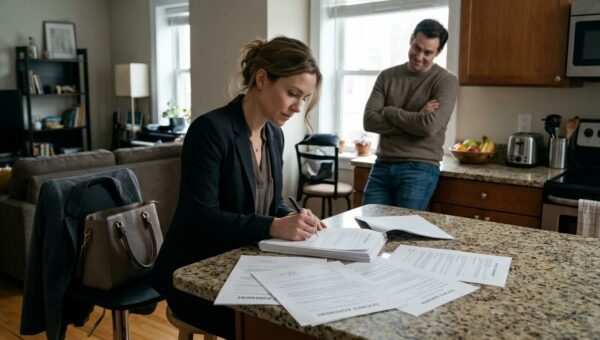
Two days after the service, I walked back into my childhood home for the first time in nearly a decade, intending only to sort through a few boxes of my old childhood photograph albums and personal mementos before driving back home to resume wedding preparations with Mark. The house looked remarkably unchanged, preserved like a museum of a family that had died years ago. Brenda was sitting at the kitchen table with a stack of legal folders and a cold cup of tea, looking smaller than ever in her oversized cardigan.
She did not ask me to leave or lecture me about my years of cold silence. Instead, as I carried a cardboard box of old yearbooks into the kitchen, she stood up, walked over to the hallway closet, and pulled out a heavy, locked cedar chest that I had never seen before in my life. She placed it gently on the kitchen table, her hands shaking slightly as she slid a small, silver-plated key across the wood toward me. “Your father and I agreed that if anything ever happened to him before you found peace, I had to give you this,” Brenda said, her voice cracking with an emotion I could not quite place. “I know you hated me, sweetheart. God knows I carried that hatred every single day because I deserved it in your eyes. But before you lock me out forever, please, just open this chest and read the letters inside. Your mother wasn’t the saint you remember, and your father wasn’t the monster you thought he was.”
My stomach dropped as I stared at the key. My immediate instinct was to push the chest away, to scream at her that I didn’t want her lies or her justifications for destroying my family. But the profound exhaustion in her watery brown eyes stopped me. With trembling fingers, I picked up the key, slid it into the brass lock, and turned it. The lid lifted with a soft, dry creak, revealing not old photographs or financial documents, but a thick stack of handwritten envelopes tied together with a faded blue ribbon, alongside a legal medical diary bearing my mother’s unmistakable, elegant handwriting. I picked up the topmost letter, unfolded the heavy stationery, and began to read.
PART 3
The diary entries dated back to the final year of my mother’s illness, but they contained truths that completely upended everything I thought I knew about my childhood. My mother had not been the serene, gentle martyr of my memory; in the privacy of her personal journals, she confessed to a crushing prescription painkiller addiction that had spiraled out of control following her initial surgery, funded by draining our family savings and secretly pawning her grandmother’s heirloom jewelry. Furthermore, the pages detailed how she had pushed my father away, subjecting him to violent verbal tirades and locking herself in the master bedroom for days while Brenda quietly came over to cook my meals, help me with my homework, and manage the household finances so we wouldn’t lose our home to foreclosure. My mother had explicitly written in her final months: “Brenda is the only reason my daughter has a roof over her head and a cooked meal on the table. If I don’t survive this, I pray to God Brenda stays to look after them, because I have broken everything I touch.”
Stunned, I pulled out the letters tied with the blue ribbon. They were correspondence between my father and a family law attorney, detailing desperate attempts to stage an intervention and protect our household assets from creditors while keeping my mother’s addiction a secret to protect my fragile teenage pride. The most devastating revelation, however, came from a letter written by Brenda herself to my father, dated just weeks before they finally married. Brenda had tried to walk away, refusing to step into my mother’s shoes out of fear of my wrath and neighborhood gossip. It was my mother, from her hospital bed in her final conscious week, who had literally begged Brenda to promise she would marry my father, make sure I went to college, and keep our family from completely disintegrating. My mother had known she was leaving behind a broken home and had chosen her best friend to pick up the pieces, knowing full well that I would direct all my displaced grief and anger entirely at the woman who sacrificed her own reputation to save us.
I sat at that kitchen table for three hours as the afternoon sun dipped below the horizon, the letters scattered across the wood like dry leaves. Every cruel word I had ever hurled at Brenda, every holiday invitation I had rejected, every birthday card I had thrown away unread rushed back to me with crushing, suffocating force. Brenda sat quietly across the room, knitting a small baby blanket, her shoulders bowed under the weight of sixteen years of unearned punishment. When I finally looked up from the papers, my cheeks were wet with hot, scalding tears that I no longer had the strength to hold back. I walked across the kitchen floor, my legs feeling like lead, and sank to my knees beside her chair, burying my face in her lap just as I used to do with my mother, sobbing apologies that had been sixteen years overdue.
ENDING
Brenda’s frail hands gently stroked my hair, her fingers trembling against my scalp, whispering that she had forgiven me the moment I was born. When Mark and I were married six months later in a small, sunlit garden ceremony, Brenda did not sit quietly in the back row as a tolerated guest of circumstance. She walked down the aisle on my arm as my mother, standing proudly beside the altar to witness a second chance at family that we had both fought so hard to reclaim. We spent the following autumn clearing out the rest of the house, laughing through our tears as we found old photograph albums and shared memories of the woman who had loved us both in her own complicated, fractured way. When my first daughter was born the following year, we named her Brenda, ensuring that the woman who had carried our family through its darkest winter would forever be woven into the fabric of our future.