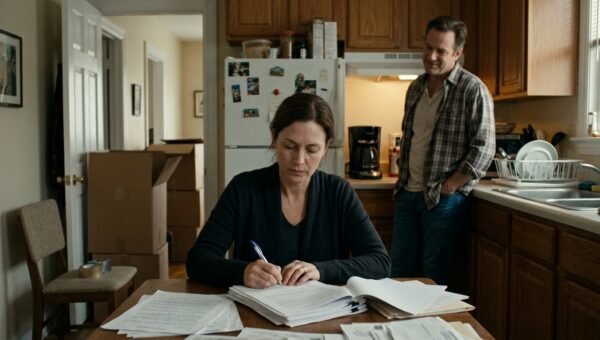
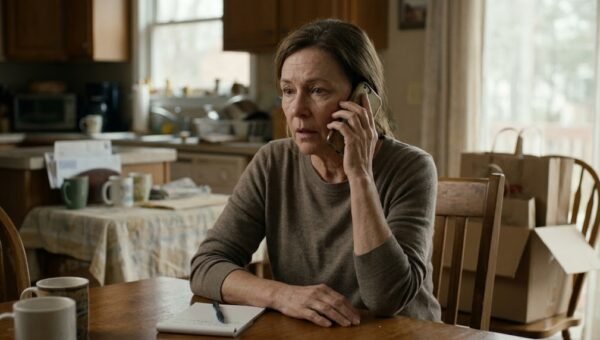
I had one slice of grocery-store lemon cake left on my plate when the knock came. It was my 65th birthday, and nobody from Karen’s house had called. I figured that was that for the day. Then I opened the door and found Maya, my fourteen-year-old granddaughter, with a backpack and two grocery bags.
“Mom thinks I’m at a sleepover,” she said.
I moved aside. “You’d better come in.”
She looked at the bags, then at me. She’d gone quiet after stepping inside, like she’d been practicing what to say and lost it at the door.
Finally, she handed me a bank envelope with my name written across it.
“Grandma,” she said, “Mom told us you stopped loving us. Then I found these hidden under the floorboards in her closet.”
The envelopes inside were all addressed to Maya or her younger brother. I recognized my own writing. Three years’ worth of birthday cards, every one still sealed.
I didn’t ask her to explain right away. I put the kettle on because it was what my hands knew to do, and Maya sat at the kitchen table with both grocery bags between her feet. One bag had a broken paper handle. She’d tied it in a knot.
I was careful with my first question. “Are you safe at home?”
“Yes,” she said. “I just needed to know.”
That was the part I understood. She hadn’t come to punish anybody. She’d come because she needed the truth from me, and I needed to be able to tell it without making her carry my anger.
Three years earlier, Karen had called about her kitchen. She wanted $20,000 for a remodel. Not a loan with a payment plan. She said she needed me to help, and she expected me to say yes.
I had the money, technically. It was part of what I’d saved for retirement, and I told her I wasn’t going to use it for a new kitchen. I was willing to talk about other ways to help. I was not willing to hand over that much money.
Karen went quiet for a moment. Then she said, “You’ve chosen money over family.”
I said, “No, Karen. I’m choosing not to spend my retirement savings on cabinets.”
That was not my best line. I knew it as soon as I said it. It was sharp, and I was mad that she’d treated a boundary like a betrayal. Still, I didn’t take the money out.
After that, I stopped getting invitations to the kids’ birthdays. Karen said it was too hard to have me there when I’d made my choice.
I sent cards anyway. I mailed them with a check or a savings bond, depending on the year, and wrote a few lines about what I remembered from the last time I’d seen them.
I didn’t call every day. I told myself I was respecting Karen’s wishes. That was partly true. It was also easier than hearing her tell me again that I’d hurt the family. I can admit that now.
I mailed cards for Maya and her brother, even when I had no idea if they’d get them. I wrote about Maya’s crooked front tooth, then the day it finally came out. I wrote that I still remembered her little brother insisting that every dog was named Buddy. Ordinary things. The kind I thought a grandmother was supposed to remember.
For three years, I got no reply. No thank-you. No angry note. Nothing. I kept mailing them because stopping felt like agreeing that I didn’t care.
Maya stared at the envelope in front of her. “I found them today,” she said. “I was looking for a duffel bag.”
She’d gone into Karen’s walk-in closet to find luggage for the sleepover she was supposed to be having. One of the cedar floorboards was loose. Under it was an old lockbox. The envelopes were inside, stacked and still sealed.
“Was it locked?” I asked.
“No. It had a little latch. I lifted it.”
She said she knew the handwriting before she read my name. She’d seen my writing on old birthday cards from before the fight. Karen had told her I stopped sending them.
Maya opened one envelope with a careful finger. The paper made a soft tearing sound. I saw the date before I saw the letter. It was for her eleventh birthday.
She read the first few lines to herself, then stopped. I didn’t reach for the card. I let her decide.
“Is this what you wrote?” she asked.
“Yes.”
She turned it around and looked at the back, as if there might be something else hidden there. Then she pulled out the savings bond slip. It was still there, with her name printed on it.
The rest of the envelopes were the same. Some held cash I’d sent for birthdays. Some held bonds for the children. Every one was still inside the card.
“Why would Mom keep these?” Maya said.
I didn’t know. I still don’t know what Karen told herself. Maya thought maybe her mother meant to destroy them. She said the money and bonds were probably why the cards were kept, though Karen couldn’t cash the bonds without admitting she’d received them.
That sounded possible. It also sounded like the kind of answer a kid shouldn’t have to work out about her own mother.
I told Maya I wasn’t going to guess at Karen’s reasons. “I can tell you what I did,” I said. “I wrote to you. I sent these. I didn’t stop loving you.”
She nodded, but she didn’t look relieved. Not yet.
Then she untied the broken handle on the grocery bag and tipped the contents onto the table. There were school certificates, art projects, a couple of photos, and track ribbons. She picked up one of the certificates and rubbed a thumb along the folded edge.
“I thought you didn’t want any of it,” she said. “Mom said you threw the things we mailed in the trash.”
I had never received anything from them. Not one drawing. Not a photo. I’d asked Karen once if the kids could send me pictures. She’d said the kids knew where to find me if they wanted to.
Maya had brought what she could carry. She’d taken a bus across town with the bags and the envelope because she wanted me to see what I’d missed. She’d been told I didn’t care, and she’d believed it for years.
I kept my voice level. “I’m sorry you thought that.”
“Were you mad at us?”
“No. I was mad at your mother. I should’ve found a better way to stay in touch. But I never blamed you.”
I didn’t say that I could have tried harder. I could have called the school, or asked someone else in the family to pass a message along. I could have pushed instead of backing off when Karen shut the door. I was trying not to make Maya responsible for the parts I’d handled badly.
Still, I had to tell Karen she was safe. I couldn’t let my daughter wake up to a missing child and think I’d helped Maya disappear. So I called her.
Karen answered on the second ring. “Where is Maya?”
“She’s here. She’s safe.”
“You need to put her on the phone.”
“She can talk to you when she’s ready. I’m telling you where she is.”
“What have you been telling her?”
“Nothing that isn’t true.”
Karen began speaking louder. She said Maya had lied about the sleepover. She said I was using a confused child to get back at her. I stayed by the kitchen counter and watched Maya sort her ribbons into a pile.
“Bring her home,” Karen said.
“I’ll tell her you want to talk. You can come here if you want to see what she found.”
There was a pause. “What is that supposed to mean?”
“It means come in person.”
Karen hung up. I didn’t feel brave. I felt like I’d just made an already bad night worse. But I wasn’t going to put the phone down and pretend Maya hadn’t come.
Karen arrived about forty minutes later. She came through the front door fast, still holding her purse strap in one hand. She looked at Maya first, then at me.
“Get your things,” she said. “We’re going home.”
Maya didn’t move. Karen turned to me. “You’re turning her against me.”
I didn’t answer that. I took the envelopes from the table and laid them out between us. The postmarks faced up. I put the savings bond slips beside them. The grocery bags were still on the floor, full of the school things Karen had said I threw away.
Karen looked at the envelopes. Then she looked at Maya.
Maya’s voice was low. “You told me she never wrote.”
That was all. Karen opened her mouth, but nothing came out at first.
I didn’t raise my voice. I didn’t need to. The dates were right there. The cards had my handwriting, and the postmarks showed I’d kept mailing them. The bonds still had the children’s names on them. No story Karen told could change where those envelopes had been or who put them in the mail.
Karen finally said she’d been angry. She said she didn’t want the kids getting caught in the middle of our fight. I told her that wasn’t what she’d done. She’d told them I abandoned them, while keeping the proof that I hadn’t.
“You didn’t have to do this,” I said.
“I didn’t know what to do with them,” she replied.
That was the first honest thing she’d said all night, or close to it. I didn’t tell her it was enough. It wasn’t.
I told her I wasn’t apologizing for refusing the $20,000. I told her she could be angry at me, but she couldn’t keep telling the children I’d walked away. And I told her I wasn’t going to let her control whether Maya could contact me anymore.
Karen said, “You can’t just go around me.”
“I’m not asking you to like it,” I said. “I’m telling you the truth.”
Maya looked at her mother. “I want to talk to Grandma myself.”
Karen said they were leaving. Maya gathered the track ribbons and papers, but left the framed photo on the table. I didn’t try to stop her from going home with Karen that night. Karen was still her mother, and Maya had made her own choice to come. I wasn’t going to turn the kitchen into another place where adults pulled at her.
Before they left, I gave Maya my mobile number on a piece of paper. She put it in her pocket. Karen saw me do it and said nothing.
The next week, I called the bank and asked how to handle the savings bonds so the money would go to the children and not be spent on something else. I set up accounts for them with the bank’s help. Karen would not have access to use the money. It wasn’t a grand gesture. It was what I should have done with the gifts in the first place.
Maya began texting me directly. At first it was mostly small things. A picture of a school project. A question about whether I still had an old photo of her. She didn’t ask me to forgive her mother, and I didn’t ask her to choose sides.
Karen hasn’t apologized. She hasn’t said the cards were wrong to hide. She still thinks I should have helped with the kitchen. That part is between her and me.
But the lie is over. Maya knows where the cards came from, and she knows they were mailed. I’m not going to make her prove that to me again.
On my birthday night, after the house got quiet, I stacked the opened envelopes neatly on the kitchen table. Maya had left one 8x 10 track photo behind. I propped it against the salt shaker and sat there under the warm pendant light, looking at the girl I’d kept writing to.