I was wrong about my daughter’s marriage, and I learned it from a church bulletin I nearly folded into my purse.
I was sitting in my usual pew last Sunday when I saw the announcement. Dr. Naomi Harris had given $24,000 to start a scholarship for local students going into medical careers. I read it twice. The paper had a crease through Naomi’s name, so I smoothed it with my thumb and read it a third time.
For a few seconds, I told myself there must be another Dr. Naomi Harris. Then Martha, who sits beside me most Sundays, leaned over and said, “That’s your girl, isn’t it?”
I said yes. I think I said it too quickly.
Martha knew the story. Not every detail, but enough. She knew Naomi married Tariq in 2010, that I didn’t go, and that I hadn’t seen her since. Martha had seen the clinic, too. “She and her husband run it together,” she said. “They’re good to people.”
The bulletin was still open across my lap. I wanted to say something about how long it had been, or how complicated things were. Instead I looked at that figure again. Twenty-four thousand dollars. Naomi had given it to the town where she grew up, to help young people get into medicine, including kids from our church.
I had spent sixteen years saying I was protecting my family.
That’s what I told myself when Naomi first said she was engaged to Tariq.
She was twenty-four. He was Muslim, and I had already decided what that meant before I had bothered to know him. I had seen him a handful of times. He was polite. He asked about my garden. He listened when Naomi talked.
I called that an act. I thought his good manners were a way to get her away from us. I had no facts for that. I had my fear, my church friends’ opinions, and a few verses I had read in a way that suited me.
Naomi tried to talk to me in my kitchen. I remember the sound of the refrigerator clicking on. I remember that I kept wiping the same clean spot on the counter with a dish towel.
“I love him, Mom,” she said.
“You know what this means,” I told her.
“I know you’re worried.”
“I’m not sending you off without saying what I believe.”
She looked tired, but she didn’t raise her voice. That made me angrier, if I’m honest.
I wanted her to fight me, because then I could tell myself I was standing firm against something.
Instead she said, “I’m still your daughter.”
I told her she had to choose. I told myself I was giving her one last chance to come to her senses. When she didn’t, I refused to attend the wedding.
At the door, while she was leaving, I said, “You’ll regret this.”
I meant the marriage. I meant that she would come back, sorry and ready to admit I had been right. I thought of it as a warning. It was an ultimatum, and I knew enough to know the difference.
She married Tariq anyway.
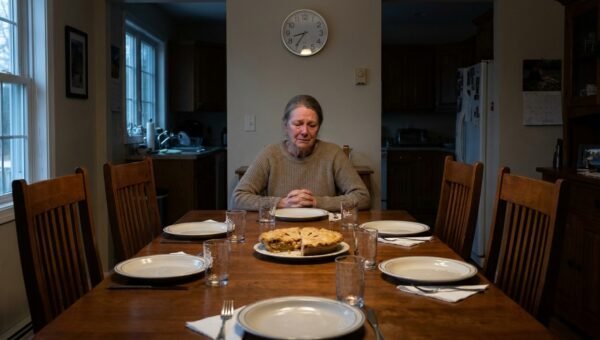
That Christmas, I put out six plates. I don’t remember deciding to do it. I just set them down as I always had, then looked at the extra one and put it back in the cabinet. The plate made a small clack against the others. I went on with dinner.
I did it again the next year. And the year after that.
Six plates, then one put away. I told myself I was leaving room for Naomi to come home. That sounds generous when I say it now. At the time, I also expected her to call and apologize. I expected her to give in first, because I was her mother and because I was certain I had done the hard, righteous thing.
No call came.
The years passed in ordinary pieces. The church replaced the carpet. Martha’s husband got sick, then better. I saw Naomi’s name once in a local paper when she finished medical school. I cut the article out and tucked it in a drawer. I didn’t call her. I told myself it would only make things harder.
There are ways to make a choice over and over without saying you’re making it. I got good at that.
The bulletin in my hands made those sixteen years look different. Naomi hadn’t come back to ask me to approve of her life. She had built one. She’d become a doctor and opened a community clinic with Tariq. She had children. She had given money to help local kids follow the same kind of path.
Martha touched my sleeve. “You could go see her,” she said.
I folded the bulletin, then unfolded it. “She may not want to see me.”
“That’s up to her.”
I didn’t like hearing that. It was true, which was worse.
After the service, I went home long enough to get my keys. I could have waited a day. I could have asked someone what they thought, then found a reason to stay put. Instead, I drove to Naomi’s house on Elm Ridge.
I knew the street from the address printed in a clinic notice Martha had shown me months earlier. I had never gone looking for the clinic. I had made a point not to.
At a stop sign, I remembered the wedding day. I had been home in my good dress, the one I wore to church weddings. I told myself I wasn’t going because I loved Naomi too much to pretend I approved. I remember the dress had a loose thread at the cuff. I kept twisting it between my fingers while I waited for a call that never came.
No one called to beg me to come.
I arrived at the bungalow and sat in the car for a minute. Then I got out, walked up the front path, and lifted my hand.
I didn’t knock right away. I stood there with the folded bulletin in my purse. I was old enough to understand that a door can open and still not let you back into someone’s life.
I knocked.
A girl answered. She looked about fourteen. She had Naomi’s eyes, the same way of looking straight at me without being rude.
“Hi,” she said. “Can I help you?”
I started to say my name, but it came out too softly. I tried again.
“I’m Naomi’s mother.”
The girl’s face changed just a little. Not fear. More like she was putting a fact where it belonged.
“I’m Maya,” she said.
My granddaughter. Fourteen years old. I had never heard her voice before.
“I’ll get Mom,” she said, and stepped back.
I wanted to ask if Naomi had told her about me. I wanted to ask whether she knew why I hadn’t been there. I didn’t ask. Maya called toward the back of the house, and a moment later Naomi came into the hall.
She looked like herself, though older. Her hair was pulled back, and she had reading glasses in one hand. I had imagined this meeting for years without meaning to. In those made-up versions, Naomi was always crying or angry, and I always had the right words ready.
I had none of them.
“Mom,” she said.
“Naomi.”
She looked at my purse. I knew she could see the edge of the bulletin inside. “Do you want to come in?”
I nodded. That was all I could manage.
The entryway had family photographs on a narrow sideboard. I saw Naomi in a graduation gown. I saw Tariq beside her, smiling at the camera. There were two children in other pictures, one younger, one older. Maya leaned against Naomi in one of them, and my daughter’s arm was around her shoulders.
I had missed all of it. Not one big event. Years of small ones. School pictures. Birthdays. The kind of pictures people take because someone said, “Wait, get one of us.”
I kept looking, so Naomi said, “We can sit in the living room.”
The room had books on a low shelf and a couple of coats hanging near the door. I heard someone moving in the kitchen. It sounded like a home. I don’t know what I had expected, exactly. Maybe I thought I would see a place built around the choice she had made against me. There was nothing like that. There was just her life.
Tariq stepped into the room a moment later. I had not seen him since before the wedding. He looked older, too. He didn’t glare at me or ask what I wanted. He said, “Hello. It’s good to see you.”
The kindness in his voice made it harder to keep the story I had told myself.
“Hello, Tariq,” I said. “I’m sorry.”
He nodded once. “Thank you for saying that.”
Naomi asked whether I wanted tea. I said yes. Maya went to the kitchen with her, leaving me with Tariq for a minute. He asked how I was doing. I gave him the usual answer, then heard myself say it and felt foolish.
“I’m all right,” I added. “Most days.”
“I’m glad,” he said.
No speech. No demand. He didn’t make me pay right there for all the years I had treated him as a threat.
Naomi came back with tea. I sat on the edge of the sofa and took the folded bulletin from my purse. I had smoothed it so many times that the paper was soft along the crease.
“I saw this at church,” I said.
Naomi looked at the announcement. “Yes. We set up the scholarship this year.”
“Why that church?”
She held the cup by its handle. “Because I grew up here. Kids here need help. I didn’t want to make it about what happened between us.”
I had no defense ready. I couldn’t point to her generosity and turn it into proof that I had been right. She had given to the town without asking the town to apologize for me. The choice had been hers, and it had nothing to do with bringing me back into her life.
“I thought you’d come to regret marrying him,” I said.
Naomi didn’t answer right away. Tariq sat beside her, close enough that their shoulders touched. She looked at him, then back at me.
“I never regretted marrying Tariq,” she said. “I regretted walking down the aisle without you.”
I looked down at my hands.
“That was hard,” she continued. “I wanted you there. I wanted you to know him. But I couldn’t keep asking you to love me only if I did what you wanted.”
I was ready to say that I had been worried about her faith, her future, our family. I could hear the words lining up. I had used them all before. This time I didn’t say them.
“I said you’d regret it,” I told her. “I’m the only one who did.”
That was the plain truth. I had spent sixteen years telling myself I had sacrificed something for Naomi. I had not sacrificed my pride. I had fed it, year after year, and called the empty place at Christmas proof that I was still waiting for her.
Naomi put her cup down. She didn’t reach for me, and I didn’t ask her to. She said, “I’m glad you came. But I can’t act like those years didn’t happen.”
“I know.”
“I want to take this slowly.”
“I understand.”
“No lectures about my faith. Or Tariq. Or how we’re raising the kids.”
“I won’t do that.”
She watched my face for a moment, perhaps checking whether I meant it. I did. I wanted to say I had always loved her, but love had been there the whole time. It had not kept me from hurting her. I needed to offer more than the word.
“I was wrong,” I said. “Not just about him. About thinking I could make you choose and still call it protection.”
Naomi looked down at the bulletin between us. “I believe you’re sorry.”
I wanted her to say she forgave me. I wanted her to take the whole thing off my hands. I kept that want to myself.
Maya came back into the room and asked if she could have a cookie. Naomi told her to take one. The small exchange carried on around me, familiar to them and new to me. I was glad to hear it. I was ashamed that I had to be glad from a sofa I’d never sat on before.
Naomi asked whether I could come for tea next Tuesday. Just tea, she said. We could talk again and see how it felt.
“Yes,” I said. “I’d like that.”
I stood to leave. Tariq walked me to the door. Maya said goodbye from the hall. Naomi stayed beside us, and for a second I thought about hugging her. I didn’t assume I could.
“I’ll see you Tuesday,” she said.
“I’ll be here.”
The drive home took less time than the drive there. I didn’t turn on the radio. I kept thinking about how I had treated that empty chair like a message to Naomi, when she had never been there to see it. The only person who had sat with that absence was me.
At home, I went into the kitchen and opened the sideboard cabinet. The sixth plate was near the bottom of the stack. I lifted it out and carried it to the counter.
Next Christmas, I mean to set all six plates on the table. I don’t know yet who will sit where, or how many visits it will take before the room feels less strange. I do know I won’t put this one away tonight.
I left the sixth plate beside the others on the counter.