I was smoothing the paper plates into a neat stack when Diane put a typed schedule beside Emma’s birthday cake. The candles were still in the box. My mother-in-law tapped the top page with one finger and said, “Starting next month, she’s with us every other weekend. Our lawyer says grandparents have rights.”
The room went quiet. My husband had been dead fourteen months, and I had never stopped Diane and Robert from seeing Emma.
I picked up the paper. It listed alternating holidays, two weeks in the summer, and Friday pickup from school. It looked like a custody plan, right down to the line for signatures.
“You filed something?” I asked.
Diane smiled. “We’re protecting our relationship.”
Across the room, Emma had stopped opening a present. She came close to me and whispered, “Grandma said a judge can make me sleep there even if you say no.”
I folded the schedule once. “Who told you that?”
Diane started to answer, but Emma had already looked down at the floor. I could feel the other parents watching us, pretending not to. So I put the paper under my hand and told everybody we were going to sing. I wasn’t going to turn my daughter’s birthday into a courtroom, especially when I didn’t even know if there was a case.
I got through the cake. I took pictures. I thanked people for coming and sent them home with leftover slices wrapped in foil.
My fingers smelled like birthday candles and orange soda. Diane stayed long enough to kiss Emma on the head, then left without taking the schedule back.
That night, after I tucked Emma in, I sat on the edge of her bed. She had her birthday crown beside her pillow, one of the elastic strings stretched out.
“Is a judge going to make me go?” she asked.
“No,” I said. “Nobody gets to tell you that without talking to me first.”
“But Grandma said it was already decided.”
I asked her what else Diane had said. I tried to keep my voice even, though I was mad enough to feel it in my teeth.
Emma picked at a loose thread on her blanket. “She said Grandpa and her could make Daddy’s room at their house. If I help you understand, I can sleep there.”
I didn’t answer right away. She missed her dad. We all did.
Diane and Robert had a box of his old things and a picture of him as a boy in their hallway. I’d let Emma visit them because I thought the connection mattered. I had not understood that Diane was making Emma feel responsible for keeping it.
“Did Grandma tell you to say that to me?” I asked.
“She said it was a secret until the party.”
That was the part that stayed with me. Not the schedule. Not even the lawyer talk. The secret.
I told Emma she hadn’t done anything wrong and that grown-up problems were mine to handle. She nodded, but she watched my face like she was checking whether I meant it. I stayed until she fell asleep, then carried the folded paper to the kitchen and put it in a drawer.
Monday morning, I checked the county court docket online. I searched my name, Diane’s, Robert’s.
I checked twice because I didn’t trust the first result. There was no petition. No filing. Nothing.
I still called a family lawyer. Her name was Karen Miller, and she had a little desk fan that clicked every time it turned. I remember that because I kept looking at it while she read Diane’s schedule.
“This isn’t a court order,” she said.
“Could they get one?”
Karen asked me whether I’d blocked visits or kept Emma from them. I told her no. I had invited them to school events, had them over for dinner, and let Emma spend daytime hours with them. I was not proud that I’d said yes to every visit even when I was tired. I’d told myself it was better for Emma.
“Based on what you’ve told me, they don’t have facts showing you’re unfit or that you’ve cut them off,” Karen said. “The law gives a fit parent a lot of protection. A judge doesn’t just hand out a schedule because grandparents ask.”
She explained that the rules depended on the facts and the state, and that there was no guarantee about what anyone might try to file. But Diane’s paper had no legal force. Karen said pressuring me to sign a private, notarized agreement by claiming a case existed was a serious warning sign.
I asked if I should sign anything.
“No,” she said. “Not until you understand exactly what it is and why you’re being asked to sign it.”
I paid for the consultation out of the account I’d been stretching since my husband died. It wasn’t money I had lying around. Still, I felt better leaving with a clear answer than I would have felt signing something because Diane had scared Emma.
I asked Karen to prepare a formal letter telling Diane and Robert not to make legal threats to Emma or discuss court with her. I also wanted a meeting. I didn’t want to do it in front of my daughter, and I didn’t want to keep guessing what Robert knew.
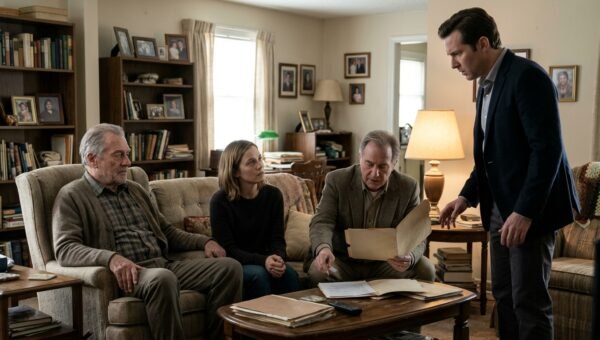
Three weeks later, I sat across from them at my dining table. Emma was with a friend from school. I had put the folded schedule between us, along with Karen’s letter.
Diane came in carrying her purse against her chest. Robert followed her and sat down without taking off his jacket. He looked older than he had at the party, though it had only been a few days.
Diane glanced at the paper. “I hope this isn’t going to be a lecture.”
“I checked the court records,” I said. “There’s no case.”
She shifted in her chair. “We talked to a lawyer.”
“I did too. That schedule isn’t an order, and you haven’t filed anything.”
“We have rights,” she said. “Grandparents have rights.”
Robert rubbed his thumb along the seam of his jacket. He didn’t look at me.
I slid Karen’s letter toward Diane. She didn’t pick it up.
“You used the word judge with Emma,” I said. “She thinks someone can make her sleep at your house even if I say no.”
Diane’s mouth tightened. “I was trying to help her understand that she needs us.”
“She’s eight. She doesn’t need to be made afraid of a judge.”
“She loves us,” Diane said. “She wants to be with us.”
“She does love you. That’s why this was so unfair to her.”
Diane pushed the schedule toward me. “You’re making this sound worse than it was.”
I told her Emma had also mentioned the promise about making her father’s room at their house, and the instruction to keep it secret until the party. Robert looked up then. His face changed, not in some big dramatic way. He just stopped rubbing his thumb.
“Diane,” he said. “You told her that?”
“She was upset about her dad,” Diane said. “I was trying to make her feel close to him.”
“By telling her to help convince me?” I said.
“I didn’t say it like that.”
I looked at the typed schedule. I’d seen Diane print recipes and church notices for years. She knew how to make a page look official. This one had no court stamp, no case number, no lawyer’s name. Just dates and blank signature lines.
I asked Robert what the lawyer had actually told them.
He took a breath and glanced at Diane. She gave him a look that I knew from family dinners, the one that usually ended a conversation before it started.
This time he kept going.
“He told us we couldn’t force a schedule if you were letting Emma see us,” he said. “He said a judge would look at you as her parent, and we didn’t have a case on what we’d told him.”
Diane turned toward him. “That isn’t what he said.”
“It is,” Robert said. “He said filing would probably fail. He told us to leave it alone.”
I asked Diane whether she’d made the schedule after that meeting.
She stared at the paper. “I was trying to keep Emma in our lives.”
There it was. Not an apology. Not an answer to the question, really. But enough.
Robert looked down at his hands. “I knew it was wrong to scare her. I should’ve stopped it.”
“Why didn’t you?”
He swallowed. “I didn’t want another fight with Diane. That’s not an excuse.”
No, it wasn’t. But I believed him. Robert had spent most of his life letting Diane make the hard calls, even when he didn’t like them. It had been easier for him to stay quiet. It had also let her take the next step.
I told them I wasn’t ending their relationship with Emma. I wasn’t going to erase her father’s family or pretend she didn’t love them. But there would be no more overnights. Future visits would be daytime, supervised by me, in public or at my home, and only when I agreed.
Diane pulled the letter closer, then stopped. “You can’t punish us forever.”
“This isn’t punishment,” I said. “It’s what I need to keep Emma safe with you.”
“You’re her mother,” Robert said quietly. “It’s your call.”
Diane looked at him as if he’d walked out on her. He kept his eyes on the table.
I told her there could be no more court threats, no secrets, and no asking Emma to persuade me. If she did it again, I would stop visits. I wasn’t going to bargain over that.
Diane said, “You’re taking her away from us.”
“I’m not. I’m setting the terms.”
For a few seconds, nobody spoke. I could hear the little desk fan in my head, that soft click, click, click from Karen’s office. I had gone in worried that I’d have to fight a legal battle just to protect my daughter. I had left knowing I could refuse the paper. I still hated that I’d needed a lawyer to say it out loud.
Robert reached for the schedule. Diane’s hand moved toward it too, but he took it first. He folded it in half, then set it down.
“I’m sorry,” he said to me. “And I’m sorry to Emma.”
Diane didn’t say she was sorry. She said she needed time, then stood up. Robert stayed seated long enough to look at me.
“I’ll call before I come by,” he said.
“Please do.”
They left without the schedule. I kept Karen’s letter and put the paper in the recycling.
When Emma came home, I told her the truth in words she could understand. There wasn’t a judge making a plan. Nobody was going to take her from me. Grandma had been wrong to tell her that.
“Can I still see Grandpa?” she asked.
“Yes,” I said. “We’ll work it out together, and I’ll be there.”
She leaned against me, still wearing the paper birthday crown. I held her for a while. I didn’t tell her that family always forgives, because I wasn’t sure what that meant anymore. I told her she could love her grandparents and still tell me when something made her uncomfortable.
That night, I put her drawing from the party on the fridge. Then I went into the living room and looked at the framed picture of Emma with her dad on the mantle. The birthday crown lay beside it while Emma slept in her own bed, in our quiet house.