PART 1
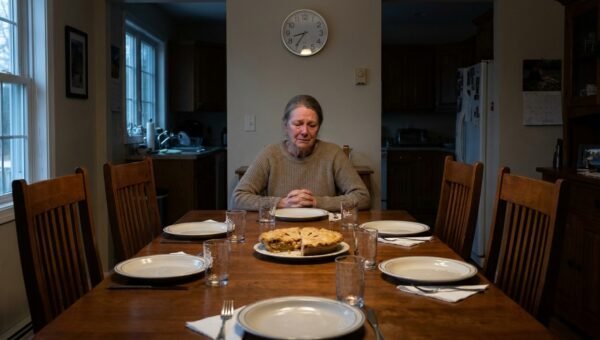
My son told me his marriage was fine, but every Sunday he showed up alone with the kids and stayed until bedtime. I almost let it go. There was more history behind it than anyone at the table seemed to remember. When Kevin married Brenda nine years ago, she made it very clear that Sunday dinners at my place were an obligation she did not care for. At first, she came once a month.
Then twice a year. By the time my grandson Leo turned eight and my granddaughter Maya was five, Brenda simply stopped coming altogether.
Kevin always had an excuse ready before he even set his keys on the counter. Brenda had a migraine. Brenda was catching up on paperwork for her accounting firm. Brenda had planned a spa day with her sister.
Whenever I tried to ask a gentle question, Kevin shut it down fast. “Mom, don’t start. She works sixty hours a week. She just needs quiet time.”
I probably would have dropped it if not for one thing: a dark, mottled bruise right under his collar one Sunday in late October.
He was reaching up into my top cupboard to grab the stack of paper plates. His button-down shirt pulled to the side, and there it was. It was roughly the size of a lemon, purplish-yellow, sitting right along his collarbone.
When he noticed me looking, he jerked his hand down, buttoned the collar higher, and turned around to fix the children’s plates like nothing happened.
I did not make a scene. I waited until I was alone, but then I changed my mind about confronting him directly in that moment. I didn’t push. I just made coffee and waited. I thought I finally had my answer, and that answer made my stomach turn cold. I assumed Kevin was hiding an abusive temper behind closed doors. Men can be victims just as easily as women, and Kevin was naturally gentle, someone who hated conflict and always yielded to keep the peace.
Dinner went on quietly. Kevin packed up leftovers in plastic containers, helped the kids with their shoes, and drove home around eight o’clock.
The next Sunday, Kevin arrived at noon as usual. The autumn air was crisp, so after lunch, I sent Maya out to the backyard swing set.
Kevin sat on the sofa with his laptop, reviewing invoices for his landscaping business.
Leo stayed in the kitchen with me, leaning against the counter while I washed the roasting pan. He was rolling a red toy car back and forth across the laminate edge. He was quiet for a long time, the kind of quiet that meant something heavy was sitting on his mind.
Then he looked up at me with round, serious eyes.
“Grandma?” he asked. “Are grown men allowed to call the police on their wives?”
The glass dish in my hand nearly slipped into the sink water. I turned off the tap, dried my hands on a kitchen towel, and pulled out the chair beside him.
“Why do you ask that, sweetie?” I asked, trying to keep my voice as steady as an ordinary conversation.
Leo stared down at his toy car. “Mom broke Dad’s phone last night.
She threw it against the kitchen tile. Then she locked him on the porch in the cold until he promised to leave the deed in her desk.”
PART 2
I kept my hands flat on the wooden table so Leo wouldn’t see them shaking.
“Did she hurt your dad, Leo?” I asked softly.
“She grabbed his shirt and shoved him against the door frame,” Leo said, his voice dropping to a whisper. “That was last week, when he got that purple mark on his shoulder. Last night she just yelled really loud about the house and threw his phone. Maya was crying in bed. Dad slept on the couch after she let him back in. He told us this morning that everything was a game and Mom was just stressed, but it didn’t look like a game.”
I looked through the open archway into the living room. Kevin was sitting there, his shoulders hunched, staring blankly at the screen of a cheap prepaid phone he hadn’t owned two weeks ago.
I didn’t storm into the living room. I didn’t scream. When someone is in that deep, cornering them with anger only makes them retreat into the fortress they built out of shame.
Instead, I gave Leo an apple slice, told him he was a brave boy, and walked into the living room.
“Kevin,” I said. “Walk out to the garage with me. The storm door latch is sticking again.”
He stood up immediately. He was always eager to fix things around my house, almost as if working with his hands gave him permission to avoid sitting still with his own thoughts.
Once the garage door clicked shut behind us, isolating us from the children, I didn’t beat around the bush.
“Leo asked me if men are allowed to call the police on their wives,” I said plainly.
Kevin stopped walking. His back was turned to me. He stood beside my old workbench, his head hanging down toward his chest. For a full minute, neither of us said a word. The only sound was the dry leaves blowing against the garage siding outside.
“He shouldn’t have seen that,” Kevin whispered. His voice was cracked.
“He did see it,” I said. “And I saw your shoulder last Sunday, Kevin. You told me your marriage was fine. You’ve been coming here every Sunday alone for nearly a year because this house is the only place your kids get eight hours of peace.”
“Mom, you don’t know the whole story,” he said, turning around. His face looked hollowed out. There were gray circles under his eyes that hadn’t been there six months ago. “Brenda is under a lot of pressure. The business had a slow summer, and she manages our books. We had an argument. She lost her temper. People lose their tempers.”
“Losing a temper is shouting, Kevin. Bruising your collarbone and locking you on a porch in October is abuse. And what deed was Leo talking about?”
Kevin flinched. That was the moment I realized the physical cruelty wasn’t an isolated eruption; it was a weapon being used for leverage.
“The house,” Kevin admitted, wiping a hand across his forehead. “She wants me to sign a quitclaim deed. She wants the house solely in her name. She said if I don’t sign it over by the end of November, she’s taking the kids to her mother’s in Ohio, filing for sole custody, and telling the court that I’m unstable and negligent.”
PART 3
The truth hit the cold concrete between us.
Brenda wasn’t merely bad-tempered or detached from our family. She was running a systematic campaign to strip Kevin of his confidence, his rights as a father, and his half of the four-bedroom colonial they had bought five years ago. Kevin had put sixty thousand dollars of his own savings into the down payment, money he had earned working sixty-hour weeks in landscaping before his knees started giving out.
“She told me no judge will believe a man,” Kevin said, his voice flat with despair. “She told me that if the police come, she’ll tell them I attacked her and she was just defending herself. Who are they going to believe, Mom? A female accountant with no record, or a tired contractor who looks rough around the edges?”
“They believe evidence, Kevin,” I told him. “And they believe the truth when you stop covering for her.”
I made him pull off his outer shirt right there in the garage. The yellow-green bruise was still visible on his shoulder, and there were fresh red nail scratches across his wrist from the previous night. I took my phone out of my cardigan pocket and took clear, date-stamped photographs of every single mark.
Then I asked him about his broken phone. He pulled the shattered device from his jacket pocket. The screen was cracked spider-web style, the glass crushed against the casing.
“Keep that,” I said. “Don’t throw it out. And you’re not going back to that house tonight.”
“Mom, I have to,” he said, panic rising in his tone. “If I don’t go back, she’ll say I abandoned the kids. She’ll use it against me.”
“Then we call an attorney first thing tomorrow morning, and tonight, you and the kids stay here under my roof. If she shows up, she deals with me.”
Kevin didn’t fight me this time. The fight had been drained out of him months ago. He just leaned his forehead against my shoulder, the way he used to do when he was a boy with a scraped knee, and let out a long, shuddering breath.
That evening, Brenda texted his prepaid phone at seven o’clock. She asked when he was bringing the kids home so she could put them to bed before her morning meeting.
Kevin showed me the text. His thumb was hovering over the screen, ready to reply with an apology.
I took the phone from his hand. “Let me dictate this. You write: ‘The children and I are staying at my mother’s tonight. We will discuss the house with legal counsel present.’ Nothing more. Do not answer if she calls.”
Kevin looked at the screen for a long time. Then he typed the words, pressed send, and powered the phone off.
Brenda called my landline fifteen minutes later. When I answered, her voice was sweet as honey, the polite persona she put on for neighbors and church acquaintances.
“Margaret, hi,” she said lightly. “Kevin seems a little confused tonight. Could you send him and the kids home? We have school tomorrow.”
“They’re sleeping here tonight, Brenda,” I said, keeping my tone as calm and hard as a brick wall. “Leo told me about the phone. I’ve photographed Kevin’s shoulder and his wrist. Tomorrow morning Kevin is meeting with a family lawyer in town. Do not come to my house.”
The sweetness vanished in an instant. “He’s pathetic,” she spat into the receiver. “You think anyone is going to care about a couple of scratches? He couldn’t manage a household if his life depended on it. If he doesn’t bring my kids home in an hour, I’m calling the sheriff.”
“Go ahead,” I said. “I’ll make sure the sheriff sees the broken phone and the bruises before you finish your sentence.”
I hung up the phone and pulled the plug from the wall jack.
ENDING
The sheriff never came that night. Bullies usually know exactly how thin the ice is beneath their feet when someone finally shines a flashlight on them.
The following morning, we sat in a lawyer’s office on Main Street. The attorney, an older woman named Sarah who handled domestic cases, looked at the photographs, the shattered phone, and Kevin’s sworn statement. She filed an emergency temporary custody order and an ex parte protective order that very afternoon.
The months that followed were not simple. Divorce rarely is, especially when property and children are involved. Brenda hired an aggressive attorney, but paper trails have a way of speaking louder than accusations. Kevin’s bank records proved his down payment; the date-stamped photos and the incident reports from that weekend dismantled her claims that he was an unfit parent.
By the following spring, the court granted Kevin primary physical custody of Leo and Maya, with Brenda receiving supervised visitation every other weekend. The house was ordered sold, and the equity was split down the middle after Kevin’s initial down payment was protected.
Kevin rented a small three-bedroom bungalow four blocks down the street from my house.
Yesterday was Sunday. The weather was warming up, and the azaleas by my porch were just starting to bloom.
Kevin walked up my front walkway around noon, holding Maya’s hand while Leo jogged ahead with a baseball glove tucked under his arm. There was color in my son’s cheeks again. He didn’t look over his shoulder when he walked, and he didn’t have an excuse prepared in his throat before he crossed the threshold.
When dinner was over, Leo helped me carry the dirty plates to the sink.
He didn’t ask heavy questions this time. He just pointed to the cookie jar on top of the refrigerator and asked if he could have two instead of one.
“Go ask your dad,” I told him with a smile.
Leo ran into the living room, and I listened to Kevin’s deep, relaxed laughter echoing off the walls. It was the first time in years that Sunday felt like Sunday.