PART 1
The day I got my medical degree, my sister Tess drove four hours in her beat-up blue sedan to sit in the seventh row. She wore a floral dress she had owned since our mother died. When they called my name, she stood up by herself and clapped so hard her hands were red.
Mom died when Tess was nineteen and I was twelve. From that day on, Tess stopped talking about community college.
She took two jobs, one at a dry cleaner and one stocking shelves on the night shift, so our childhood house would not go into foreclosure. For eleven years, she paid the gas bills, packed my lunches, bought my textbooks, and washed my scrubs.
I never saw it as sacrifice. In my head, I had done the heavy lifting because I was the one who studied until two in the morning. I thought she just had no ambition.
At the graduation dinner, my classmates were talking about their matches, their fellowships, and the prestige of our residency placements. Tess sat at the end of the table, quiet, keeping her purse on her lap. When one of my friends asked what she did for a living, she smiled politely and said she handled shift work back home.
I felt embarrassed. Outside by the parking garage, while she was reaching into her bag to hand me a card with twenty dollars inside, I let eleven years of arrogance spill out of my mouth.
“See?” I told her, holding up my diploma. “I climbed the ladder. You took the easy road and became a nobody.”
Tess did not yell. She pulled her hand back, tucked the card into her pocket, and looked at me for three seconds without blinking. Then she said, “Take care of yourself, Leo,” got into her car, and drove away.
She did not answer my calls that weekend. She did not answer them in July, or August, or September. At first, I told myself she was just pouting. I thought she would get over it once she realized how childish she was being.
Then October arrived. I took a weekend off from my residency rounds and drove down to our hometown. When I turned onto our old street, her blue sedan was parked in the driveway for the first time in three months.
The front door was unlocked. I walked straight into the hallway, expecting to find her folding laundry or watching television, ready to offer a half-hearted apology so we could move on.
Instead, the living room was stripped bare.
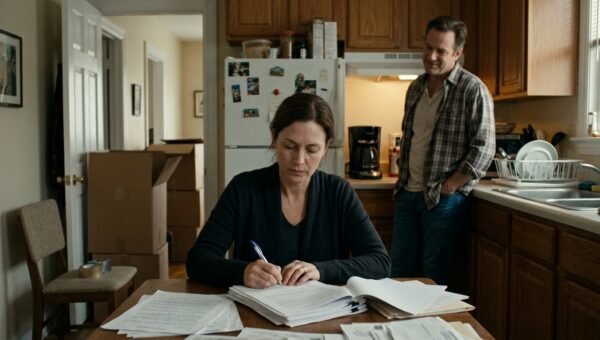
The sofa was gone. The television was gone. In the center of the hardwood floor sat six taped cardboard boxes and a plastic folding chair. Tess was sitting on that chair in a pair of gray sweatpants, wearing a winter beanie inside the house, holding a mug with both hands. Her face was hollow, her collarbones were sharp against her collar, and on the folding table next to her sat a thick stack of medical bills stamped with past-due notices in red ink.
PART 2
She looked up when the floorboards creaked. She did not jump or act surprised. She just looked at me the exact same way she had in that parking garage, tired and calm.
“What is this?” I asked. My voice sounded thin in the empty room. “Where is all the furniture?”
“Sold,” she said quietly. “Most of it went last month.”
I walked over to the folding table. As a resident, I read charts every twelve hours, but looking down at those papers made my chest ache.
The top statement was from the regional oncology clinic sixty miles away. It listed three rounds of targeted radiation, five rounds of intravenous chemotherapy, and a total outstanding balance of $41,200 after insurance denial.
The patient name on every single sheet was Teresa Vance.
“You have lymphoma,” I said.
“Stage three,” she answered. “They found it in February.”
February was four months before my graduation. In February, I had called her panicking because my board preparation courses cost $1,800 and I was short on rent. Three days later, the money was in my checking account. She had told me she picked up weekend overtime at the warehouse.
“You knew back then?” I asked.
“The doctor told me on a Tuesday,” she said, her voice completely level. “You had your final practical exam that Friday. You were already sleeping four hours a night and throwing up from nerves. If I told you, you would have dropped out or taken a leave of absence to move back here. You would have thrown away seven years of school.”
“I am a doctor, Tess,” I choked out. “You should have called me.”
“You weren’t a doctor yet,” she said. “You were my little brother, and you were almost across the finish line. My job was to get you across.”
She pointed to the stack of boxes against the wall. Inside were all the things she had kept: Mom’s silver picture frames, my high school track medals, my acceptance letters, and every report card I had ever brought home from seventh grade onward.
I picked up the manila folder beside the medical statements. Inside were pawn slips for Mom’s wedding rings, dated two weeks before my graduation ceremony. The amount on the pawn receipt was $1,200. My graduation dinner and cap-and-gown fees had totaled $1,150.
PART 3
I sat down on the bare floor right beside her chair. I could not look at the empty walls.
“You sat at that table,” I whispered. “You listened to me brag about climbing the ladder, and you let me say those words to your face.”
“You thought success meant doing it alone,” Tess said softly. “I let you believe that for a long time because I wanted you to feel strong. But that night, hearing you look down on me after everything we traded to keep you in school, it just broke whatever was left in me. I didn’t have the energy to fight you. I had a treatment scheduled for six o’clock the next morning.”
She had driven four hours home that night after my graduation, slept in her car at a rest stop for two hours, and sat in an infusion chair while poison dripped into her arm. And she had done it completely alone.
The anger and self-importance that had carried me through four years of college and four years of medical school vanished entirely. There was no pride left in my degree. It felt heavy and filthy in my hands.
“I am moving you to the city,” I said.
She shook her head. “I don’t have the money for that hospital, Leo. The bank is foreclosing on this place next month. I don’t have anything left.”
“I do,” I said.
I pulled out my phone. I had signed an employment agreement with a major hospital system that included a $35,000 relocation and signing bonus, set to disburse in two weeks, alongside my resident stipend. I opened my banking portal and called the administrative director of my hospital network on her personal line on a Saturday afternoon.
I didn’t care about looking unprofessional. I told her I had a family medical emergency, that my sister required an immediate transfer to our university oncology ward, and that I needed my advance processed on Monday morning. Then I called a local real estate agent whose number was on a flyer on the porch and told him to halt any short-sale proceedings because the mortgage arrears would be paid in full by certified funds by Wednesday.
Tess reached out and put her hand on my arm. Her fingers were cold and thin, with purple bruising along the veins from repeated IV lines.
“Leo, stop,” she whispered. “You’re going to ruin your start at the hospital.”
“Let it ruin,” I said, looking her directly in the eyes. “You ruined your entire youth so I could have one. It’s my turn.”
ENDING
We packed the six cardboard boxes into the trunk of my car that evening. She locked the front door of our childhood home for the last time, and I carried her small bag down the steps.
I transferred her care to the oncology department on the fourth floor of the hospital where I work. Every morning before my shift starts at six, I walk up two flights of stairs to check her vitals and sit by her bed while she eats oatmeal. She still hates hospital food, and she still complains whenever I spend money on parking passes.
The house back home is paid up and safe. My signing bonus went straight to the bank and her clinic bills, and half of my monthly resident paycheck goes into an account with her name on it. I wear the same two pairs of shoes and eat leftover cafeteria sandwiches, the exact way she lived for eleven years.
Yesterday, after her white blood cell count showed improvement for the second straight week, she fell asleep with the television on. On the bedside table, right next to her water pitcher, sat my framed medical diploma.
I had brought it to the room two months ago and hung it on the wall, but this morning I noticed she had taken it down and wiped the glass clean. Under the glass, tucked in the bottom right corner, was the twenty-dollar bill from the graduation card I had thrown back in her face.
I left the bill right where she put it. It reminds me every single day who actually built the ladder I was so proud of climbing.