PART 1
My husband started insisting I take sleeping pills before bed because my insomnia was “ruining both of us.”
I didn’t raise my voice. I’d learned a long time ago that arguing too early only gives people time to change their story. I kept trying to stay calm. We had been married twenty-eight years, and Greg was never a cruel man, but over the last six months, he had grown sharp around the edges.
Every night around ten o’clock, he would walk into the kitchen, fill a short glass with tap water, and set two blue capsules by my coaster.
“Take them, Sarah,” he would say, resting a hand on my shoulder. “You tossing and turning keeps me up all night. You need rest. You need to trust me.”
The pills were supposed to be over-the-counter sleep aids from the local grocery store. But they left me groggy until noon. My head felt stuffed with damp wool every morning, my tongue dry, my limbs heavy as wet towels. I could barely drive safely to my job at the municipal water office before ten o’clock. When I mentioned how bad they made me feel, Greg just brushed it off. He told me my body was adjusting, that forty years of working full-time was simply catching up to me, and that I was exaggerating.
I kept doing little chores and normal things because normal felt safer than admitting something was off.
I folded the laundry, weeded the front walk, wiped down the counters, and pretended my husband wasn’t watching me swallow those capsules every single night.
Then came Thursday afternoon.
Greg was out back behind the garage, pressure-washing the utility trailer. I was taking the recycling out through the mudroom when I caught the corner of a brown paper pharmacy bag poking out from the bottom of his canvas work tote.
I picked it up. Stapled to the outside was a receipt from the county pharmacy across town, not the corner drugstore three blocks away where we bought our vitamins. The name printed across the top was Sarah Miller, but my last name had been spelled with one l: Sarah Miler. And the date on the slip was only two days old.
Inside the bag was a clear plastic prescription bottle with a plain white cap. The label was taped over an older white sticker, and inside the bottle were small, pale peach tablets with a score mark down the center. They were not blue capsules.
I waited until I was alone the next morning. Greg left for his golf league at eight, and by nine, I was standing in front of the drive-up window at our regular pharmacy on Elm Street. I decided to walk inside instead. My regular pharmacist, Brenda, has known me since my oldest daughter had braces twenty years ago.
I pulled the bottle out of my purse and set it on the tall counter between us.
“Brenda, I found these in the house,” I said quietly. “The tablets inside look different from what my husband said he bought. Can you tell me what they are?”
Brenda picked up the bottle, looked closely at the score line, and then brought it under her magnifying lamp. She adjusted her glasses, ran her thumb over the taped paper, and scanned the tiny barcode on the side.
Her forehead wrinkled. She looked up from the counter, glanced past my shoulder toward the empty lobby, and leaned in close.
“Sarah,” she asked, “who gave you this bottle?”
PART 2
“My husband,” I said. “He told me they were sleep aids.”
Brenda turned the bottle around and set it back on the rubber mat between us. Her expression had completely changed.
“These aren’t over-the-counter sleep aids, Sarah. These are generic lorazepam. They’re a prescription sedative. A controlled substance.” She tapped the barcode on the screen. “And this prescription wasn’t filled for you. It was written for a woman named Clara Miller, filled three days ago through the county clinic pharmacy on Tenth Street. Clara Miller is eighty-two. Who is Clara Miller?”
Clara Miller was Greg’s aunt. She lived in an assisted living apartment across town, in the memory support wing. Greg was her legal guardian and handled her pension and medication pickups.
“He’s been giving me her pills?” I asked. My voice sounded flat, even to me.
Brenda shook her head slowly. “The bottle says one milligram at bedtime as needed for severe anxiety. If you’ve been taking two of these every night without a doctor monitoring your dosage, that’s why you can’t wake up until noon. That’s why you’re dizzy.” She paused, her hands resting flat on the counter. “Sarah, you cannot take another one of these. And if he gave you someone else’s prescription, that’s illegal.”
“Keep the bottle,” I told her. “Can you print me a verification slip of what’s inside?”
“I can,” Brenda said. “And I’m keeping the original right here in the safe.”
I walked out to my car with my knees shaking, but my head clearer than it had been in weeks. The wool in my mind was gone. Greg wasn’t trying to help my insomnia. He was purposely knocking me out every night at ten o’clock.
The question was why.
When I got home, the house was completely silent. The clock on the microwave read 10:15. Greg wouldn’t be back from golf until after one.
I didn’t tear the house apart. I went straight to the hall closet where we kept our fireproof metal lockbox. Greg had the small silver key on his key ring, but I knew where he kept the spare: taped behind the framed family picture of our daughter’s college graduation on the hallway wall.
I pulled the key down, unlocked the box, and opened the green file folders inside.
Everything looked normal at first. Our home deed from 1998, our car titles, our tax returns from the last three years. But tucked underneath the bottom lining of the box was a manila envelope marked only with the initials C.M.
Inside were four months of bank statements for Aunt Clara’s conservatorship account.
I sat on the hardwood floor and went down the columns line by line. Every single month, there was a scheduled transfer out of Clara’s account into a separate personal checking account under Greg’s name. The total missing over the last five months was $43,200.
Attached to the back of the latest statement was an official notice from the county probate court, dated three weeks ago. It was a formal audit demand. The court was requiring Greg to appear on November 14 to provide receipts and full accounting records for Clara’s care expenses.
And stapled to the very back was an application for a second mortgage on our house for $50,000.
My signature was already on the joint application line. It looked like my handwriting, but the slant was wrong, and the ink was fresh. Greg had forged my name to borrow fifty thousand dollars against our paid-off house to replace the money he had stolen from his demented aunt before the court could catch him.
The application required a notary seal. The appointment was set for tonight at eight o’clock at our kitchen table.
PART 3
I spent the afternoon putting things back exactly where I found them.
I took the duplicate key, taped it back behind the graduation frame, and locked the metal box. Then I called my daughter, Karen. She is thirty-four, works as an accountant at a firm downtown, and has her father’s eyes and my stubborn spine.
“Karen,” I said, “I need you to come to the house at seven tonight. Don’t call your dad. Just come through the back door and sit in the kitchen with me.”
She heard something in my tone that stopped her from asking questions. “I’ll be there, Mom.”
Greg came home around one-thirty. He smelled like cut grass and aftershave. He smiled, kissed the top of my head, and asked how my afternoon was. I told him I had folded the sheets and watered the geraniums.
“You look tired,” he said, touching my cheek. “You really need an early night.”
“Maybe,” I said.
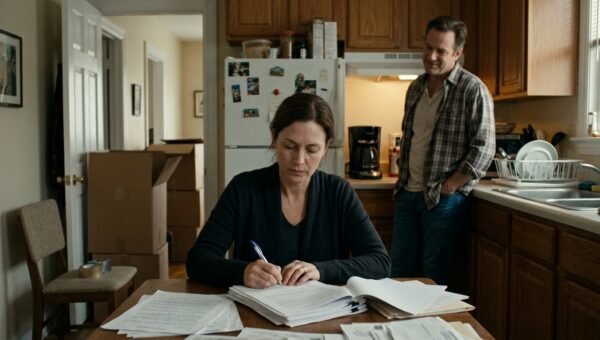
At seven o’clock, the back door clicked open. Karen walked in, hung her jacket on the peg, and sat down at the round oak table. Ten minutes later, Greg walked in from the living room, holding a folder under his arm.
When he saw Karen sitting there, he stopped.
“Karen? What are you doing here?” he asked.
“I asked her to come,” I said.
I sat at the opposite end of the table. In front of me, I placed Brenda’s printed pharmacy receipt and a clear plastic bag containing two tiny blue capsules that I had dug out from the bottom of our bathroom vanity, the real over-the-counter sleep aids he had swapped out weeks ago.
Greg looked at the papers, then at me. His face tightened.
“What is this?” he asked.
“Brenda has Aunt Clara’s prescription bottle in the pharmacy safe,” I said quietly. “She printed this for me this morning. You’ve been drugging me with your aunt’s lorazepam every night so I wouldn’t wake up while you were working in the dining room.”
Greg’s jaw clenched. “Sarah, you’re not making sense. You were stressed out, you weren’t sleeping—”
“I saw the lockbox, Greg,” I interrupted. I didn’t raise my voice. I kept it as level as the kitchen counter. “I saw the probate audit notice. I saw the $43,200 missing from Clara’s accounts. And I saw the equity loan application with my forged signature on the bottom.”
The room went completely still. Karen looked from me to her father, her mouth opening slightly.
“Dad?” Karen said. “What is she talking about?”
Greg didn’t look at her. He looked only at me. The comfortable, easygoing expression he had worn for nearly three decades vanished entirely.
“I was going to put it back,” he said. His voice was lower now, rough around the edges. “I made a bad investment on commercial storage units with Dave last winter. It went south. Clara didn’t need that cash sitting in savings; her facility was paid up through December. I just needed fifty thousand from the house to clear the court audit, and then I was going to pay the house back over five years. I was protecting us.”
“You weren’t protecting us,” Karen said, her voice shaking. “You forged Mom’s name to put a lien on their house. And you medicated her so she wouldn’t notice you doing it?”
“She would have panicked!” Greg snapped, slamming his palm flat against the wood. “You know how she gets about debt! She would have refused to sign, and then the court would have removed me as conservator! I could have gone to jail!”
“You should go to jail,” I said.
He stared at me. He looked smaller suddenly, an ordinary man in golf khakis who had run out of lies to tell.
ENDING
The mobile notary arrived at eight o’clock sharp. Greg had to walk out to the driveway in the dark and turn the woman away himself.
I didn’t pack his bags for him. I told him to take what he needed for a week and stay at the extended-stay motel by the bypass. He tried to argue, tried to reach across the table to take my hand, but Karen stood up between us and told him that if he didn’t leave by eight-thirty, she would call the county sheriff and report Clara’s missing medication immediately.
He left with one duffel bag and his golf clubs.
The next morning, Karen drove me to see an attorney who specializes in elder law and family estates. By Friday afternoon, we had filed a petition with the probate court to have Greg removed as Clara’s conservator and replaced by a neutral county administrator. We turned over the bank statements and the audit notice. The attorney worked with the court to freeze Clara’s remaining funds before any more could disappear.
My name was never put on the loan. The house remains completely in my name and free of any mortgage lien.
Greg is currently under investigation by the county prosecutor’s office for the missing $43,200. His lawyer has reached out twice to propose a repayment settlement using his share of our retirement accounts, and my attorney is currently preparing the divorce papers to make that division permanent.
I sleep in our bedroom alone now.
The first couple of weeks were hard. My body had to adjust to sleeping without any sedatives at all, and there were nights when I stared at the ceiling until three in the morning, listening to the floorboards creak and the wind brush against the gutter outside.
Last night, I walked into the kitchen around ten o’clock. The counter was clean. There was no short glass of tap water waiting by the coaster, and no pills sitting by my mug. I poured myself a mug of warm chamomile tea, turned off the kitchen light, and went upstairs to bed.
I didn’t fall asleep right away, but when I finally did, it was on my own terms.