PART 1
My wife insisted we stop celebrating my birthday after I turned sixty because she said parties were childish. We had been married thirty-two years, and for most of those decades, I had been the person who smoothed the edges, paid the bills on time, and kept the peace. When she looked across the kitchen island that morning and told me that grown men do not need fuss, candles, or family dinners, my first instinct was to swallow it again.
I did not want one bad moment to become a family war.
So on the Saturday of my sixtieth, I spent the afternoon cleaning gutters, sweeping dried pine needles off the roof, and eating a turkey sandwich over the sink while she stayed upstairs in her sewing room. I told myself it did not matter. A birthday is just a number on a driver’s license. If you repeat something often enough, you can almost force yourself to believe it.
Four months later, in the middle of October, my wife spent three straight weeks running around the house with color-coded clipboards. Her coworker, a project manager named Greg who had joined her regional office two years earlier, was turning forty-five. Suddenly, milestone birthdays were not childish at all.
“His year has been really hard,” she told me when I found six packs of linen napkins stacked on our dining table. “His divorce got messy.
The whole branch wants to lift his spirits, Arthur. It’s about morale.”
I stood by the dining room doorway, looking at the silver streamers and the matching place cards. Part of me wanted to pretend I had not noticed the difference between her two rules. If you do not push, you do not find out what is broken. But once you ask the right question, you cannot always go back to the old version of your family.
“I thought big parties were silly after a certain age,” I said quietly.
She did not even look up from her clipboard. “Greg is going through a transition. You have a stable home and a wife. You don’t need a pat on the back for living another year.”
I did not argue. I helped her load five folding tables into the back of her SUV on a Friday evening. I stayed home that night while she drove over to the local community hall where the office was gathering.
When she came home after midnight smelling of cheap champagne and sheet cake, she kicked off her shoes and went straight to bed without saying two words.
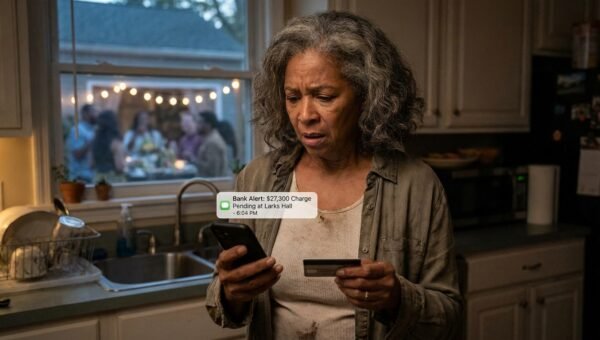
The next Tuesday, our monthly visa statement arrived in my email inbox. I always reconciled our household accounts on the fourteenth. When I opened the ledger, I expected the usual groceries, water bill, and gas charges.
Instead, there was an unfamiliar pending charge for $2,780 at a private hospitality catering shop downtown called Hearth & Table.
I stared at the numbers. Two thousand seven hundred and eighty dollars. We were careful people. We did not carry balances. I thought our card number had been stolen at a pump or skimmed at a restaurant. I immediately logged into the card portal, opened the electronic merchant receipt to file a fraud report, and clicked the itemized details.
There was no fraud. The billing address was our home. The purchaser name was my wife, Brenda Miller.
I scrolled through the line items: braised beef sliders, craft cider barrels, linen rental, and private venue staffing. But there was still one detail left at the bottom of the invoice.
The last line item was a two-tiered almond cake with buttercream piping. The custom inscription request had been typed into the bakery notes:
“Happy Birthday, Bear. Here is to our fresh chapter.”
Bear was not a workplace nickname. It was the private name Brenda had called me since the second month of our courtship in 1991.
PART 2
I did not call Brenda right away. In thirty-two years of marriage, I had learned that confronting someone while your hands are shaking only gives them room to turn your shock into an argument about your tone.
I downloaded the PDF invoice and saved it to my private flash drive. Then I printed two copies on our small home printer. Looking at the paper in black and white made it real. $2,780 charged directly against our joint savings cushion. She had told me the branch chipped in for Greg’s party. She had told me the office gathered ten dollars a person in an envelope on the break room counter.
That night, Brenda came home from work around six. She dropped her keys into the ceramic bowl by the front door and complained about traffic on Route 9.
“Did you take the trash out to the curb?” she asked, walking into the kitchen without looking at me.
“I did,” I said.
She opened the refrigerator, pulled out a pitcher of iced tea, and poured a glass. She looked tired, the same way she had looked for the past two years, distracted and slightly annoyed by whatever room she happened to occupy.
I walked over to the kitchen table, pulled out a chair, and laid the printed receipt face up between the salt shaker and the napkin holder.
“I was doing the monthly books,” I said. “I thought this was fraud at first.”
Brenda set the tea glass down on the counter. The glass made a sharp clink against the granite. She walked over to the table, glanced down at the paper, and her face went stiff. She did not gasp. She did not ask what it was. Her mouth tightened into a hard, defensive line that I had seen before whenever she knew she had crossed a line.
“The office collection came up short,” she said, her voice dropping. “People promised to Venmo me, and half of them flaked. I had to put the deposit down so we didn’t lose the hall. I was going to move money from my personal account on Friday.”
“The whole charge cleared five days ago, Brenda,” I said. “And the invoice wasn’t just a hall deposit. It was the food, the bar, and the cake.”
“It got out of hand,” she said, crossing her arms. “I was trying to do something nice for someone who was sinking. Why do you look through the statements like an auditor looking for a crime?”
“Look at the last line,” I said.
She looked down at the receipt again. She did not read it out loud. Her fingers twitched against her forearms.
“It says ‘Happy Birthday, Bear,'” I said. “And ‘Here is to our fresh chapter.’ Did the office collection dictate that inscription too?”
For three full seconds, the kitchen was dead quiet. The hum of the refrigerator seemed louder than usual. Brenda looked up from the table, but she did not look at my eyes. She looked somewhere past my shoulder, toward the dark living room.
“It was an inside joke,” she said. The lie was so thin, so clumsy, that it sounded like an insult to the thirty years we had spent together. “He had a rough transition. The team called him that because of how grumpy he was in morning meetings.”
“You haven’t called me Bear in five years,” I said. “You told me sixty was too old for candles. You told me wanting a dinner with our kids was childish. But you took nearly three thousand dollars out of our joint money to buy an almond cake for another man.”
“Arthur, stop,” she snapped, her voice finally breaking its calm. “Don’t make this into something vulgar. You don’t know what my days look like. You don’t know how empty this house feels sometimes.”
That was the tell. If it had been an innocent office mistake, she would have apologized for the money and laughed off the nickname. Instead, she had shifted the blame to our house, to our marriage, and to me.
I picked up the receipt, folded it neatly into thirds, and slid it into my shirt pocket.
“Where are you going?” she asked as I picked up my car keys.
“I’m going to take a drive,” I said. “And when I come back, you’re going to tell me the truth about what that money was actually buying.”
PART 3
I did not go far. I drove to the municipal parking lot behind the library, parked under a streetlamp, and sat in the front seat with the engine running.
I knew Greg’s last name because it had been printed on the flyer Brenda had left on our printer weeks ago: Gregory Vance. A quick search on my phone showed his social media account. It wasn’t locked.
The photos from the Saturday party were right there, uploaded three days earlier. There were forty people in the hall, balloons, a catered buffet, and Greg standing in the center holding a glass. In two of the photos, Brenda was standing beside him. She was wearing the navy dress she had bought for our niece’s wedding two summers ago, laughing with her hand resting lightly on his forearm.
And on the cake table sat the rectangular two-tiered cake from Hearth & Table, with the inscription clearly written in blue frosting: “Happy Birthday, Bear. Here is to our fresh chapter.”
Below the photo, one of Greg’s friends had commented: “Lucky guy. When is the official move?”
Greg had replied: “Working out the lease details now. Next month.”
My chest felt hollow, but my thoughts were cold and clear. The fresh chapter wasn’t an inside joke. Brenda hadn’t just organized a birthday. She was planning to leave. She had used our shared household account, the account funded by my pension checks and her salary, to throw a celebration for the life she was preparing to step into.
I drove back home. The kitchen light was still on. Brenda was sitting at the table with her hands wrapped around an empty mug. Her suitcase was not packed, but her purse was sitting next to her coat on the chair.
I walked in, pulled out the chair across from her, and sat down.
“Greg is moving into an apartment next month,” I said plainly.
Brenda did not look up from the mug. “Arthur, please.”
“Are you going with him?” I asked.
She closed her eyes. A heavy breath escaped her, not of regret, but of someone tired of carrying a disguise.
“We talked about it,” she said, her voice barely above a whisper. “Nothing physical happened until last month. I swear to God, Arthur. I was confused. He needed help, and for the first time in ten years, someone looked at me like I mattered.”
“You took twenty-seven hundred dollars from our joint account to pay for his party,” I said. “You told me you stopped my birthday because grown men don’t need fuss. But you wanted to play wife for him in front of his friends with my money.”
“I was going to replace it,” she whispered.
“You were going to walk out the door,” I said. “That’s what the fresh chapter was. You just wanted to humiliate me on the way out so you didn’t feel guilty about leaving.”
“That’s not true,” she cried. “I was unhappy! Why can’t you see that I was dying in this routine?”
“Because if you were unhappy, you could have asked for a divorce,” I told her, keeping my voice steady. “You could have sat in this exact chair, told me it was over, and divided our assets like two adults who shared thirty years. Instead, you made me feel small on my sixtieth birthday so you could feel generous to him.”
The reality of what she had done sat between us. There were no dramatic speeches left to make. The truth was out on the table, ugly and small.
I reached into my pocket, took out the folded receipt, and set it next to her mug.
“Tomorrow morning, you are going to transfer $2,780 from your personal checking back into our joint account,” I said. “And then I am calling an attorney to start the paperwork for a legal separation.”
Brenda looked at me, her eyes wide. “Arthur, we can talk to a counselor. Thirty-two years doesn’t just disappear over one mistake.”
“It wasn’t one mistake,” I said. “It was three weeks of planning, five folding tables in my car, and thirty-two years reduced to a cake inscription you stole from our youth. I am done keeping the peace.”
ENDING
Brenda did not move in with Greg. When the news of the party and the shared account reached the branch through an HR inquiry after she attempted to expense part of the invoice, Greg distanced himself quickly. By December, he had transferred to an office two states away.
Brenda transferred the $2,780 back into our joint account the very next morning, just as I asked. Two weeks later, she moved into an extended-stay suite near the interstate while our lawyers worked out the division of our property. We sold the house in May. We split the proceeds evenly down the penny, along with our retirement balances. She tried to call twice to talk about what had gone wrong, but there was nothing left to explain.
I bought a small, two-bedroom brick ranch on the north side of town, close to the municipal park. It has a small front porch, mature oak trees, and gutters that I can clean from a six-foot stepladder without risking my neck.
Last Saturday was my sixty-first birthday.
My daughter, Sarah, drove down from Columbus with her two boys. They brought paper plates, a bucket of fried chicken, and a grocery store chocolate cake with crooked white lettering that said, “Happy Birthday, Dad.”
My seven-year-old grandson blew out half the candles before I could even make a wish, and the icing tasted too sweet, the way cheap frosting always does. We laughed about it until our sides hurt, sitting on folding chairs in my unfinished living room while the sun went down behind the oaks.
After they packed up the car and drove away, I went back inside and washed the plates in the sink.
The house was completely quiet, but it was not empty. I sat down at my clean kitchen counter, cut myself one more small corner of chocolate cake, and ate it in peace.