PART 1
Five months ago, I stood in my daughter’s hallway holding a blue fleece blanket I had spent three weeks binding by hand.
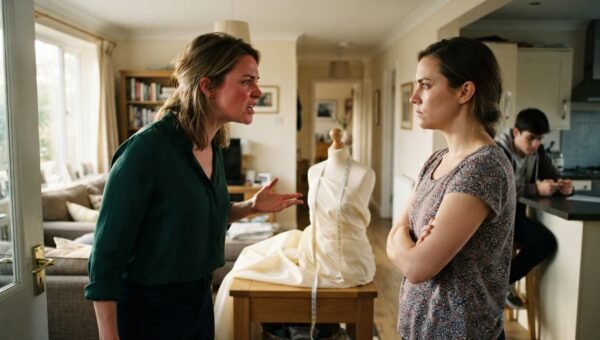
Andrea was twenty-four, standing in the doorway of her bedroom with her arms crossed over her chest. The baby was sleeping in a bassinet behind her, wrapped tight in a white hospital swaddle. I had driven forty minutes with a pot of beef stew in the front seat and diapers in the trunk, but Andrea would not let me step past the rug in the entryway.
“You can leave the food on the counter,” she said. Her voice was flat and hard, the way she used to talk when she was sixteen and trying not to cry.
“Can I just hold him for a minute, Andy?” I asked. “Just one minute so you can eat?”
She did not look at the stew, and she did not look at the blanket. She looked right into my eyes.
“You were never a real mother to me,” she said. “You worked sixty hours a week and left me with neighbors. You don’t get to play grandma now. Don’t touch him.”
The words felt like a slap across the mouth. I stood there for five seconds, listening to the small ticking clock on her wall. I did not yell. I did not argue. When Andrea was eight, her father left us with four thousand dollars in credit card debt and an old furnace that quit every November.
I took extra shifts at the county billing office because keeping the lights on was the only way I knew how to love her. But you cannot explain thirty years of exhaustion to a girl who only remembers cold dinners.
I laid the blue blanket across the back of her kitchen chair, set the stew on the stove, and walked out to my car. I sat in the parking lot until my hands stopped shaking, and then I drove home. I decided that if she hated me that much, I had to let her be.
Five months went by without a single text.
Then, on a rainy Tuesday in October, my home phone rang at two in the afternoon.
“Is this Martha Vance?” a woman asked.
“Yes, it is,” I said.
“Mrs. Vance, this is Brenda from the St. Jude Pediatric Urgent Care on 14th Street. Do you have a daughter with a small scar beneath her left ear?”
My grip tightened on the receiver. Andrea had gotten that scar when she was seven, falling off her bicycle onto the gravel curb in front of our house.
“Yes,” I said. “That is Andrea. Is she okay? Is the baby okay?”
The nurse lowered her voice. “Your daughter brought an infant in about twenty minutes ago for a chest cough. When the triage desk took the intake bag, we found a plastic hospital birth bracelet tucked in the side pocket. It had your name on it, Mrs. Vance. It listed Martha Vance as the mother.”
“My name?” I asked. “That makes no sense. I am fifty-seven years old.”
“When we asked your daughter about it, she got extremely defensive,” Brenda said. “She told us it was a clerical mistake from the hospital, but she started shaking and would not give us her own identification. We need you to come down here right away.”
I did not even grab my raincoat. I drove fifteen miles across town through sheets of grey rain, my mind spinning through every dark possibility.
The clinic was a low brick building tucked behind a strip mall. I pushed through the glass doors, my shoes squeaking on the linoleum. The waiting room was empty except for an elderly man with a cane.
Brenda, a heavy-set woman in navy scrubs, met me at the reception counter. She did not waste time with pleasantries. She signed me in on the visitor log and led me down a narrow hallway to Exam Room 3.
Inside, sitting on a paper-covered examination table, was a clear plastic bassinet. Inside the bassinet, my grandson was sleeping, wearing a faded yellow onesie that was a size too small. His cheeks were flushed, and his breathing had a shallow, raspy rattle.
On the stainless steel counter beside the crib lay two plastic hospital bands.
I walked over and picked them up.
The first band was blue. It read: *Infant Boy Vance. Mother: Martha Vance. Date of Birth: May 12.*
The second band was white, lying right next to it. It had the exact same date of birth: *May 12.* But the printed line beneath it read: *Mother: Andrea Vance.*
I stared at the two bracelets, my throat completely dry. Before I could turn around to ask Brenda what this meant, she stepped back into the doorway, reached for the brass deadbolt, and turned it until the lock clicked firmly into place.
She looked at me with tight, grim eyes.
“Mrs. Vance,” she said quietly. “Your daughter left the building two minutes before you pulled into the lot. She walked out the side exit alone.”
PART 2
The sound of the deadbolt clicking shut seemed to echo in the small exam room.
“Why did you lock the door?” I asked, my voice rising. “What do you mean she left?”
“State protocol,” Brenda said, keeping her voice strictly level. “When a parent leaves an infant unattended in a medical facility without completing discharge or transferring legal custody, we are required to secure the room and notify facility security. We have to make sure nobody walks out with this child until social services arrives.”
“I am his grandmother,” I said.
“I know,” Brenda said gently. “That is why I called you before I dialed the county hotline. Look in that canvas bag on the chair.”
Beside the examination table sat a worn grey diaper bag with a broken zipper. I unzipped the main pocket with trembling fingers. On top of three loose diapers lay a manila folder stuffed with crumpled papers.
The first paper was a final notice from Memorial Hospital, dated three weeks earlier. The total balance due was $34,800. Across the top was a red stamp that made my stomach twist: *INVESTIGATION PENDING – IDENTITY FRAUD FLAG.*
Beneath the bill was a typed letter from the hospital’s billing audit department. It stated that on May 12th, a patient presenting a state employee health insurance card belonging to Martha Vance had been admitted for labor and delivery. However, during morning rounds on May 13th, the attending nurse realized the patient was in her early twenties, while the insured member on file was fifty-seven. When confronted, the patient broke down, admitted her true identity, and the hospital issued a secondary band in her legal name, transferring the entire uninsured bill to Andrea Vance.
I leaned against the stainless steel counter, holding the paper under the fluorescent lights.
Everything came rushing back to me with brutal clarity. In April of last year, Andrea had come over to my house to borrow my iron. She had stayed in my kitchen for an hour, unusually quiet. My purse had been hanging on the coat rack by the back door, and my spare insurance card was in the zipper pocket.
Andrea had lost her job at the dental office when she was five months pregnant. Her boyfriend had walked out two weeks after the pregnancy test turned positive. She had no savings, no health coverage, and no idea how she was going to pay twenty thousand dollars to deliver a child. In her panic, she thought she could use my card at the hospital desk, give birth, and slip away before anyone checked the birth year.
She had failed. The hospital caught her within twelve hours.
They handed her the debt, kept the fraudulent records on file, and threatened her with legal action if she did not set up a payment plan.
When I showed up at her apartment five months ago with that handmade quilt, Andrea had not been angry at my mothering. She was terrified. The hospital bills were sitting on her kitchen table. The fraudulent wristband was sitting in her drawer. She was drowning in thirty-four thousand dollars of debt, convinced that if I stepped into that apartment, I would see what she had done.
She had called me a terrible mother because it was the fastest, cruelest way to push me out the door before she broke down and confessed.
“Mrs. Vance,” Brenda said, interrupting my thoughts. “The baby has mild bronchiolitis. He needs an albuterol treatment and monitoring. But your daughter told the triage nurse she was going out to feed the parking meter. She left her coat. She left her keys on the counter, took only her purse, and walked out.”
“She has another set of keys,” I whispered. “She has an old blue Civic.”
Brenda’s radio chirped on her hip. She clicked the button. “Go ahead, Frank.”
A male security guard’s voice came through the speaker, crackling with static. “Brenda, the blue sedan from the visitor lot didn’t leave the property. It is parked behind the dumpster near the delivery dock. The engine is running, but nobody is getting out.”
PART 3
I turned to Brenda immediately. “Give me ten minutes. Please.”
“Mrs. Vance, I have a legal obligation to call the county intake line,” Brenda said, her voice tight with professional hesitation.
“I know your obligation,” I said, looking her straight in the eyes. “And I know what happens to a five-month-old baby the minute the state takes custody on an abandonment report. You called me because you wanted this child to have his family. Give me ten minutes to bring his mother back through that door. If I can’t bring her in, call whoever you have to call.”
Brenda looked at the baby sleeping in the bassinet, then looked back at me. She reached down, clicked the deadbolt open, and stepped aside.
“Ten minutes, Martha,” she said. “Not eleven.”
I walked out the side exit into the freezing October rain. The cold water soaked through my cotton blouse in seconds, but I barely felt it. I rounded the brick corner of the building and walked toward the delivery dock.
There, tucked between an industrial grease bin and a row of wooden pallets, sat Andrea’s battered blue Civic. Exhaust was puffing from the tailpipe in white clouds.
I walked up to the passenger side, pulled the handle, and opened the door.
Andrea was sitting behind the wheel, her hands gripping the plastic rim so hard her knuckles were yellow. Her forehead was resting against the center of the steering wheel. The radio was off. The only sound was the clicking of the heater fan blowing lukewarm air onto her wet sneakers.
She flinched when the cold air hit her, but she did not look up.
“Go ahead and call the police,” she whispered, her voice muffled against the plastic. “I know they’re coming anyway. The hospital sent three letters this month. They said they were turning the file over to the district attorney.”
“Nobody called the police, Andy,” I said, sliding into the passenger seat and pulling the door shut against the rain.
“I ruined everything,” she sobbed, her shoulders hitching. “I can’t buy his milk, Mom. My landlord put an eviction notice on my door yesterday. The electricity in the kitchen went out on Sunday because I couldn’t pay the seventy-dollar disconnect fee. I thought… I thought if I brought him here and left your bracelet on his bag, they would just give him to you. I thought you would raise him, and he would have a clean house, and you wouldn’t have to look at me.”
She finally lifted her head. Her face was blotchy and red, her eyes swollen almost shut.
“Why did you say those things to me five months ago?” I asked gently. “About me not being a real mother?”
A fresh wave of tears spilled down her cheeks. “Because I stole your card,” she cried. “I took it out of your purse like a thief. I was so ashamed of what I did, and I was so scared you would look at me and see a criminal. If you held him, you would have looked at his hospital band. You would have asked why the paperwork had your name. I knew if you hugged me, I would just collapse and tell you, and I couldn’t bear to see you look at me with disgust.”
She pulled her knees up against the steering wheel, burying her face in her denim jacket. “I told myself you were a bad mother so I wouldn’t have to admit what a failure I was.”
I sat in the cold car for a moment, listening to the rain drumming on the tin roof.
I remembered all the nights I had worked double shifts at the county office, coming home at midnight to find her asleep on the sofa with her homework unfinished. I had spent twenty years feeling guilty for not being home enough, and she had spent five months suffocating under a debt she thought would destroy us both.
I reached across the console, turned the ignition key to the left, and shut the engine off. Then I took her cold, trembling hand in mine.
“You made a terrible choice with that insurance card, Andrea,” I said plainly. “It was wrong, and it was stupid, and we are going to have to deal with the hospital. But you did not abandon your son today because you are evil. You ran because you were drowning.”
She looked at me, her lower lip trembling. “They won’t let me keep him.”
“They will if you walk back through that door with me right now,” I said. “We have eight minutes before that nurse picks up the phone. Get out of the car.”
ENDING
We walked back into the clinic side by side, our clothes dripping water onto the floor tiles.
When Brenda saw Andrea walk through the door, the tension in her shoulders dropped visibly. She did not lecture Andrea. She did not scold her. She simply unlocked the exam room, handed Andrea a warm blanket, and said, “He just woke up. He needs his mother to hold him while we do the breathing treatment.”
The county social worker still had to come, because a formal inquiry had been logged the moment Andrea stepped outside. But because Andrea returned voluntarily and because I was there as immediate family support, the baby was not removed. We signed a thirty-day voluntary kinship agreement: Andrea and little Leo would move into my three-bedroom ranch house that very evening, with me acting as the temporary supervisory guardian.
The financial mess took real work to untangle.
Three days later, I took Andrea to the financial counseling office at Memorial Hospital. We did not hire an expensive lawyer, and nobody went to jail. We sat across from a stern, middle-aged woman named Mrs. Gable and laid every single paper on her desk.
Andrea signed a formal confession of error, admitting she had presented my card in a state of panic without my knowledge or consent. Because Andrea had zero income and was facing eviction at the time of delivery, Mrs. Gable helped us file retroactive applications for emergency Medicaid and the hospital’s community charity care fund.
It took seven weeks of paperwork, utility bills, and bank statements, but the hospital’s charity board agreed to absorb $31,200 of the original bill under their indigent care provisions. The remaining $3,600 was converted into an interest-free payment plan of $75 a month, which Andrea pays herself from the part-time clerical job she started last month at the public library.
Leo is ten months old now. His cough cleared up within a week of moving into my house, and his cheeks are round and healthy.
Yesterday afternoon, the sun was shining through the big front window of my living room. Across the hardwood floor lay the blue fleece blanket I had sewn nearly a year ago. Leo was sitting on the center of it, banging a wooden spoon against an empty plastic mixing bowl.
Andrea was sitting on the floor beside him, her hair pulled back in a ponytail, helping him stack plastic rings on a peg.
I walked in from the kitchen carrying a fresh basket of laundry. As I set the basket on the coffee table, Leo lost his balance, tipped sideways, and let out a startled little whimper.
Andrea did not freeze, and she did not pull away. She reached down, scooped him up against her chest, and patted his back with a steady, practiced rhythm until he settled down against her shoulder.
Then she looked up at me over his head.
“Mom,” she said quietly. “Can you hold him for twenty minutes while I finish the dishes?”
I walked across the room, reached down, and took my grandson into my arms.