PART 1
My mother-in-law, Evelyn, complained at every Sunday dinner for twenty-eight years that I excluded her from our family albums. She told the relatives I took pictures of everyone except her. The truth was completely different. Whenever I brought out the camera at birthdays or Christmas, Evelyn found a reason to walk into the kitchen, check her purse in the hall, or turn her back to look out the window. She avoided lenses like they could steal something from her.
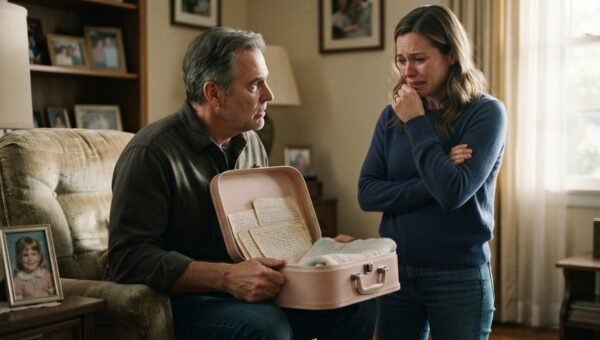
When my husband, David, died of a sudden stroke last autumn, the house felt too quiet. Four days after the funeral, before David’s clothes were even packed into donation boxes, Evelyn walked into my living room with three plastic totes. She demanded every single photo album we owned.
“They’re my memories of my son,” she told me, her voice flat and tight. “You have your own people. David was mine first.”
I was too exhausted from grief to argue with a seventy-two-year-old woman. I let her stack the albums into her bins. She took twenty-eight years of our holidays, backyard barbecues, and anniversary trips. But I kept one small album. It had belonged to my maternal grandmother, bound in faded green linen, filled mostly with old black-and-white family portraits from the 1960s. The only modern picture inside it was an extra eight-by-ten print from David’s and my wedding day in October 1994, which my grandmother had slipped into the back sleeve before she passed away.
Seven months went by. Evelyn barely answered my phone calls, treating me like an acquaintance whose contract had expired with David’s death. In May, I decided to preserve my grandmother’s album by scanning each page to a hard drive.
When I reached the very last page, I lifted the plastic film to slide our wedding portrait out so the glass flatbed wouldn’t create a glare. A smaller, glossy print slid out from behind the heavy cardstock. It had been wedged tightly between the backing paper and our wedding photo for decades.
I picked it up, expecting another snapshot of my cousins.
It was a color print stamped on the back with July 1993.
The image showed Evelyn standing on the granite steps of the county courthouse downtown. She was wearing a beige trench coat I distinctly remembered her wearing back then. Beside her stood Mark Davis.
Mark had been my first real love. We had lived together in a rented duplex for two years and talked about marriage constantly.
Then, in the second week of June 1993, Mark walked out to buy milk on a Saturday morning and never came back. His clothes were gone by Sunday evening. His car was gone. He left no note, no forwarding address, and his phone line was disconnected within forty-eight hours. Two weeks after he vanished, I was crying in the breakroom at the civic center where I worked, and David, who was doing the electrical wiring on the second floor, sat down beside me and offered me half his sandwich.
Now, thirty-three years later, I was looking at a photograph of Mark and David’s mother.
They were standing close together outside the municipal building, their hands both gripping the corners of a thick manila envelope. Mark was looking straight at the lens with a faint, uneasy grin. Evelyn was looking directly into his face with an expression of sharp, hard control.
My hands began to shake so badly the glossy paper rattled. Mark had disappeared in mid-June 1993. This picture was taken three weeks later, right in our city, while I was still calling local hospitals and weeping on my mother’s couch.
I grabbed my car keys, left the scanner running on my desk, and drove straight to Evelyn’s house.
I didn’t knock. I used the spare key David had kept on his ring and pushed open her front door. She was sitting at her kitchen table with a cup of black tea, a magnifying glass in her hand, sorting through the very albums she had stripped from my home.
I walked up to the table, reached past her teacup, and slammed the 1993 photograph face-up onto the wooden surface.
Evelyn didn’t jump. She adjusted her glasses, lowered her head, and stared at the print. Her fingers curled slowly into her palms, but she didn’t look away.
For two full minutes, neither of us said a word.
Finally, she let out a slow, dry breath.
“I hoped your husband would never learn why you were available to marry him,” she said quietly.
PART 2
“What is this, Evelyn?” I asked. My throat felt raw. “Why were you with Mark? Why are you holding that envelope?”
She leaned back in her chair. Her face looked smaller than usual, lined with age and grief, but her eyes held that same rigid stubbornness she had carried my entire marriage.
“You think your life just happened, Sarah,” she said, her voice barely above a murmur. “You think you and David meeting was fate. People like you always believe in fate because it saves you from looking at the dirt under your feet.”
“Mark walked out on me,” I said, leaning over the table. “I thought he was dead. I spent six months thinking he’d been murdered or run off the road into a ditch. And you were meeting him at the courthouse three weeks after he left?”
“He didn’t leave because he died,” Evelyn said. “He left because he was a coward who couldn’t pay his own bills.”
She pushed her chair back, stood up stiffly, and walked into her small hallway closet. I stayed where I was, staring at the glossy picture of the boy I had loved at twenty-two standing next to the woman who would become my mother-in-law a year later.
When Evelyn returned, she wasn’t holding another photo. She was holding an old gray tin box with a rusted latch, the kind people used to keep vehicle titles and birth certificates in during the eighties. She set it on the table between us and flipped the latch.
“David was twenty-four,” Evelyn said, looking down into the box. “He was working eighty hours a week for his uncle’s contracting business. He had saved twelve thousand dollars to buy his own service truck and start his independent company. He was my only boy. He worked until his knuckles bled. And he was obsessed with you.”
“David didn’t even know me until July,” I said.
“David knew you since you were seventeen,” Evelyn snapped, her voice sharpening. “You worked the front desk at the municipal pool where he did the maintenance repairs in the summers. You never looked at him. You only had eyes for that charming, smooth-talking boy from the north side of town. David would come home and talk about you until I wanted to scream. He kept your photo from the local paper when you won the community track relay. He was sick over you, Sarah. Completely sick.”
She reached into the metal tin and pulled out a canceled cashier’s check, protected inside a clear plastic sleeve. She slid it toward me.
The check was drawn from Evelyn’s personal credit union account, dated July 6, 1993.
The amount was made out to Mark Davis for exactly $15,000.
“I had to mortgage my car and take a loan against my widow’s pension to get that cash,” Evelyn said, her voice dropping. “Fifteen thousand dollars in 1993 was real money. It was everything I had put aside after David’s father died.”
I looked at the signature on the back of the check. It was Mark’s handwriting, neat and slanting to the right. Underneath his signature was a bank stamp from a branch in Reno, Nevada.
“Why?” The word came out like a rasp. “Why did you pay him?”
“Because your charming Mark came to David’s uncle looking for an off-the-books loan,” Evelyn said. “He was six thousand dollars deep in illegal sports gambling debts to people who were threatening to break his legs. David overheard him talking behind the garage. David came home that night crying, telling me that the girl he loved was living with a criminal who was going to drag her down or get her hurt.”
She pointed a crooked finger at the photo.
“Mark didn’t disappear out of the blue, Sarah. He came to me first. He knew David was watching you. He told me if I gave him enough money to pay off his debts and set up in Nevada, he would pack his bags and vanish without saying a single word to you. That envelope in the photograph held the paperwork: a signed agreement, a copy of the bank draft, and his promise never to return to this county.”
PART 3
I couldn’t breathe properly. The room seemed to tilt.
“You bought him off,” I whispered.
“I saved my son from watching you marry a degenerate,” Evelyn said coldly. “And I saved you, too, though you never had the decency to see it.”
“You didn’t save me,” I said, the fury finally breaking through the shock. “You took away my choice. You let me believe I wasn’t good enough, that the man I lived with just threw me away overnight like garbage. I spent years in therapy trying to understand what was so wrong with me that someone could walk out the door for milk and never speak to me again.”
“And what did you get instead?” Evelyn slammed her palm down on the table. “You got David! You got a man who adored you for twenty-eight years. A man who never looked at another woman, who bought you a house with a wraparound porch, who paid every mortgage note on time, and who died holding your hand. Would Mark have given you that? He was a thief, Sarah. Three years after that check cleared, he was arrested in Washoe County for grand larceny. I tracked him. I kept tabs on him until the day he went to state prison.”
She pulled another sheet from the tin. It was a newspaper clipping from a Reno paper, dated 1996. Mark’s mugshot was printed in grainy ink. He looked older, gaunt, and worn out. He had been charged with running a fraudulent check scheme.
I stared at the clipping, then back at the picture of them on the courthouse steps.
“Why was the picture taken?” I asked. “If you were paying him off in secret, why did you stand on the courthouse steps and take a photograph with him?”
Evelyn’s mouth tightened. A flicker of real uncertainty crossed her face for the first time.
“Mark brought a friend with a camera,” she admitted, her voice dropping to a harsh whisper. “The boy was paranoid. He thought I was setting him up with the county sheriff. He said he wanted proof that I handed him the envelope voluntarily, so I couldn’t report him for extortion later. He insisted we stand outside the clerk’s office, take the picture, and have his friend develop it before he got on the bus. He gave me a copy of the print to prove he had kept his side of the bargain.”
“And where did you hide it, Evelyn?”
“I kept it in my lockbox,” she said. “I never meant for it to end up in your grandmother’s things.”
“Then how did it get behind my wedding photo?”
Evelyn closed her eyes. Her shoulders slumped slightly.
“The night before your wedding,” she said quietly, “David found the tin. He was looking for his birth certificate to get the marriage license. He found the canceled check. He found the agreement. He came to my room with that tin in his hands and shook like an engine falling apart. He looked at me with so much disgust I thought he was going to hit me.”
The room went completely still.
“David knew?” I asked. “David knew about this?”
“He knew what I had done,” Evelyn said. “He didn’t know Mark was the one who proposed it, but he knew I paid him to leave. He took that photograph out of my box. He told me that if I ever told you the truth, if I ever made you feel like our family had manipulated your life, he would never speak to me again. He told me I had tainted the only clean thing in his life. He said he would take the secret to his grave so you could believe your marriage was built on real ground.”
Her voice cracked on David’s name.
“He took the picture to destroy it,” she whispered. “I assumed he burned it. I didn’t know he hid it behind your wedding portrait. He must have slipped it into your grandmother’s album because he knew I would never look through her things.”
She looked up at me, tears gathering in the corners of her faded eyes.
“That’s why I hated the cameras, Sarah. Every time you pointed a lens at me, I thought about David looking at me that night. I thought about what would happen if the truth came out. When he died, I took every album because I was terrified you would find something he had written down. I wanted to protect his memory. I wanted you to think he was pure.”
ENDING
I stood in Evelyn’s kitchen for a long time, watching her hands tremble on the table.
The anger that had carried me into her house didn’t disappear, but it shifted into something heavy and cold. My life had not been an accident. My marriage to David had been built on top of a quiet, calculated transaction, but David had spent twenty-eight years trying to shield me from the shame of it. He hadn’t orchestrated Mark’s departure, but he had inherited the silence, carrying the guilt of his mother’s check every single day we were together.
“You should have let me hurt back then,” I told her. “You should have let me figure out who Mark was on my own. It wasn’t your job to buy my future.”
Evelyn didn’t answer. She simply looked down at the canceled check for $15,000.
I picked up the 1993 photograph from the table. I also picked up the newspaper clipping of Mark’s arrest from Reno. I left the canceled check and the tin box where they lay.
“Keep the albums,” I said quietly. “You took them because you wanted his memories. You can have them.”
“Sarah,” she said, her voice small and cracked. “Are you going to tell the family?”
“No,” I said. “David kept your secret for twenty-eight years to protect me. I’m keeping it to protect him.”
I walked out of her house, got into my car, and drove home.
The scanner was still humming in my quiet office, its light bar resting against the glass. I took the small linen album that had belonged to my grandmother and set it back on the shelf. Then I walked into the hallway, took down the framed wedding portrait of David and me that had hung near our front door for nearly three decades, and looked at his face.
He was smiling in the sunshine, his arm wrapped tightly around my waist, looking at me like I was the only person in the county.
I took the 1993 photograph of Evelyn and Mark, walked out to the metal trash bin behind my garage, and dropped it into the bottom. Then I went back inside, locked the door, and sat down in the quiet house that David had built for us.