PART 1
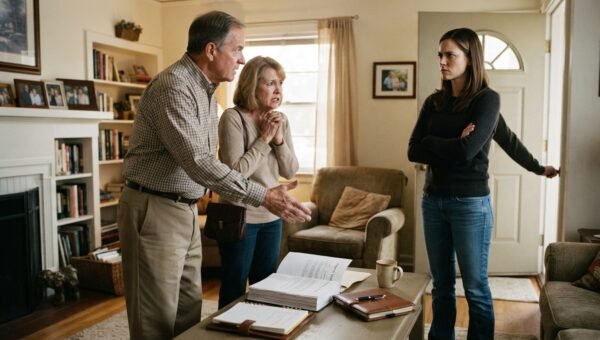
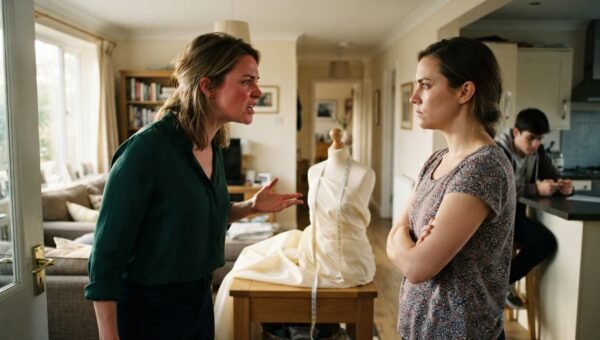
My sister-in-law, Brenda, stood in the center of my father’s kitchen on a Tuesday morning and called me a freeloader. Dad was sitting in his recliner in the adjoining room, his right side still weak from the stroke he suffered three months earlier, trying to lift a mug of warm broth with his left hand. Brenda didn’t lower her voice. She said I was using Dad’s illness as an excuse to take a long vacation, that driving his ten-year-old Buick to the pharmacy was taking advantage of the family, and that it was time for me to pack my bags, go home, and get a real job.
I didn’t scream at her. When someone attacks you while you are wiping down a counter at eight in the morning after sleeping on a fold-out sofa for ninety days, you realize words won’t reach them. My older brother, Kevin, had married Brenda four years ago, and from that first Thanksgiving dinner, she looked at Dad’s small brick house on Maple Street like an asset waiting to be liquidated.
I stopped defending myself. I stepped back, let her finish her lecture, and walked out to the porch until she drove off. But I didn’t forget how she looked around the hallway every time she came over, sizing up the hardwood floors, checking the mail pile by the rotary phone, asking why Dad hadn’t signed over power of attorney to Kevin yet.
That afternoon, I decided to protect myself. Whenever Brenda called Dad’s landline while I was helping him in the bathroom or out back hanging laundry, she left long, sharp messages.
I started saving every single voicemail. Most of them were just petty complaints about how much electricity the medical bed used, or warnings that Kevin and she were tired of subsidizing what she called “dead weight.”
Then came the voicemail from the third week of October.
She had called while Kevin was driving her home from Sunday dinner. She didn’t realize the machine had already picked up after four rings. In the background, while Dad and I listened from the kitchen table, Brenda’s voice came through clear and irritated over the car speaker.
“We need to get her out before she looks down there, Kevin,” Brenda said to him. “If she finds that basement room, everything Dad promised us goes out the window.”
Kevin’s voice was muffled, but he snapped back, telling her to shut up because he hadn’t hung up the phone yet. The line went dead with a hard click.
Dad looked at me with his good eye, his face troubled, but his speech was still slurred and slow. He pointed a shaking finger down toward the basement door near the pantry.
The next morning, when Kevin came by to drop off Dad’s blood pressure refills, I asked him straight out. I leaned against the sink and asked what Brenda meant about a room in the basement that none of us had ever seen.
Kevin didn’t look me in the eye. He set the pharmacy bag on the counter, adjusted his watch, and told me Brenda was stressed about money and talking nonsense. Then he added that the far corner of the basement had black mold behind the partition wall, that the township inspector had warned him about it, and that he had padlock-sealed the heavy door behind the fruit cellar until professional remediators could come in the spring.
“Don’t go messing with it,” Kevin said, grabbing his keys off the hook. “You’ll just kick up spores and make Dad cough.”
He left in Dad’s old Buick, saying he needed to run an errand for his lawn care company.
When he brought the car back two hours later and swapped it for his truck, he tossed the car keys into the decorative bowl by the front door.
I went out to the driveway twenty minutes later to check the tire pressure before taking Dad to his physical therapy appointment. The glove box was slightly open. When I pushed it closed, a thick wad of yellow municipal parking tickets caught in the latch. I pulled them out to straighten them, and underneath the citations, tucked inside a greasy paper napkin, sat a heavy brass mortise key with a piece of red electrical tape wrapped around the head.
My hands were shaking as I walked back inside. Dad was asleep in his chair, breathing slow and steady.
I took the key, grabbed a flashlight from the laundry shelf, and walked down the creaking wooden stairs into the cellar. Past the furnace, past the old canning jars covered in cobwebs, stood the rough-cut plywood door Kevin had put up three years earlier. The brass padlock wasn’t there anymore. Instead, there was a heavy deadbolt built right into the frame.
The key turned with a loud, mechanical snap.
There was no smell of mold. The air was dry, cool, and smelled like cedar shavings and old paper. I clicked on the flashlight and swept the beam across the space. The room was twelve feet deep, lined with clean steel shelving. Stacked neatly from floor to ceiling were dozens of gray archival boxes. Every single box had a date written in Dad’s careful drafting handwriting, and every date was from before my parents were married in 1974.
I walked to the very last shelf in the shadows. Sitting by itself on the bottom row was a small cedar chest with my full name handwritten across a white masking tape label.
The box had two brass clasps. Wrapped tightly around the center clasp, holding the latch shut like a makeshift lock, was a wide gold band. I pulled it close to the light. It was Kevin’s wedding ring.
PART 2
I stood in that cold cellar with Kevin’s wedding ring in the palm of my hand. It was a heavy, brushed-gold band with a tiny scratch near the inside hallmark, the exact ring Brenda had given him at their church wedding four years ago. Two weeks after Dad’s stroke, Kevin had shown up at the hospital with a bare left hand, swearing he had dropped his ring down an open storm drain while clearing gutters at a commercial job site. Brenda had made a huge scene in the waiting room, crying about bad omens and demanding he replace it with insurance money.
He hadn’t lost it. He had used it to bind a box he never wanted me to open.
I worked the gold band off the brass clasp. It was wedged tight, but the metal gave way with a scrape against the wood. My heart hammered against my ribs, not with fear, but with the cold dread of knowing my family had been keeping a ledger I knew nothing about.
Inside the cedar chest, nestled on top of a folded wool baby blanket, lay an olive-green metal lockbox. Next to it was an envelope with my name on it in Dad’s neat hand, postmarked from Chicago in August of 1972, two full years before Mom and Dad were married in Ohio.
I sat down on an overturned wooden crate under the single hanging bulb, pulled the letter from the yellowed envelope, and read.
The letter was from a woman named Clara Vance. She had written it to my father when he was twenty-four years old and working as a structural draftsman. It was short, polite, and devastating. She wrote that she understood his family would never accept a child born out of wedlock, especially with his father being a deacon, but that she could not raise a baby girl alone on a seamstress’s wages. She wrote that she had signed the formal surrender papers at the county courthouse, trusting him to keep his word to place the baby in a safe home where she would be loved.
Under the letter was a certified birth certificate. My name was on it. Clara Vance was listed as the mother. The father’s name was left blank. Stamped in red ink across the top was an adoption finalization seal dated June 14, 1974, naming Arthur and Martha Miller as my legal parents.
I sat there for twenty minutes without moving. All my life, I had believed I was Dad’s younger biological daughter, born when he and Mom were in their early thirties. Kevin was five years older than me. Mom had always treated me with a quiet, careful gentleness, while Kevin had always been the golden boy who could do no wrong. Mom died of breast cancer ten years ago, taking this secret to her grave.
I looked at the steel shelves around me. I walked down the row, reading the labels on the other boxes.
*Clara Vance Letters: 1972-1985.*
*Clara Vance Support Receipts: 1975-1990.*
*Property Deed, 412 Maple Street: 1971.*
I pulled down the folder marked *Property Deed*. Inside was the original deed to the house we were standing in. Dad hadn’t bought it with Mom. Clara Vance had inherited the property from her grandmother in 1970, and in 1973, she had transferred the deed solely into Arthur Miller’s name with a binding covenant recorded in the county land office: the house was to be held in trust for her infant daughter until her fiftieth birthday, or transferred to her directly upon Arthur’s death.
I was turning fifty in three months.
A floorboard creaked directly above my head. Footsteps moved across the kitchen linoleum, heavy and hurried. Then came the rattle of car keys dropped onto the counter, followed by Brenda’s sharp, high-pitched laugh.
“Arthur, stop mumbling,” Brenda’s voice carried down the heating duct. “Kevin’s just looking for the paperwork. You don’t need this house anymore. The assisted living place out on Route 9 has a bed open on Monday, and the deposit is due by five.”
I heard Dad’s walking cane strike the floor once, hard. Then a thud, like a chair shifting violently.
I slipped Kevin’s wedding ring into my jeans pocket, grabbed the deed file and my adoption record, clicked off the flashlight, and stepped silently up the stairs.
PART 3
When I pushed open the basement door, Kevin was standing at the kitchen table with a blue legal folder open in front of him. Brenda was leaning over Dad’s recliner, holding a ballpoint pen toward his left hand. Dad was leaning away from her, his jaw clenched, his good hand gripping the armrest so hard his knuckles were white.
“Just make an X, Arthur,” Brenda was saying, her voice dripping with artificial patience. “The notary is meeting us at the bank at noon. Kevin can’t sign the listing agreement without your mark, and you know you can’t manage these stairs.”
“Put the pen down, Brenda,” I said.
Brenda jumped, dropping the pen onto the braided rug. Kevin whipped around, his face flushing red the moment he saw the gray folder tucked under my arm.
“What were you doing down there?” Kevin demanded, taking a step toward me. “I told you that area was condemned. You had no right to go picking through Dad’s storage.”
“You lost something, Kevin,” I said evenly. I reached into my pocket, pulled out his gold wedding band, and set it on the kitchen table right beside his blue legal folder.
Brenda stared at the ring. Her mouth fell open, her eyes darting from Kevin’s face to the gold band. “Where did you get that? Kevin, you said that washed down the sewer on Elm Street.”
“Shut up, Brenda,” Kevin snapped, his voice cracking.
“He used it to keep me out of a cedar chest,” I said, looking right at my brother. “The chest with my birth certificate from 1972. And the original deed to this house.”
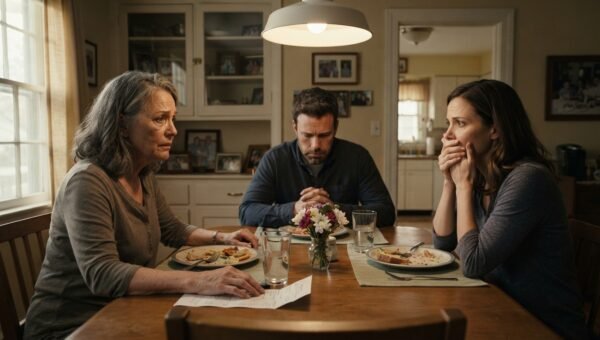
The kitchen went dead quiet. The only sound was the hum of the refrigerator and Dad’s heavy, uneven breathing from the chair.
Kevin looked at the floor. “You don’t understand how it was back then. Mom told me the whole story before she died. Dad had an affair before they got married. He brought you home, and Mom agreed to raise you as her own so nobody at church would find out. But this house was supposed to be mine. I’m the son. I’ve taken care of the lawn, I fixed the roof, I stayed in this town while you went off to college.”
“You didn’t stay to take care of him, Kevin,” I said, pointing toward Dad. “You stayed because you wanted the house. And Brenda wanted to flip it before Dad’s memory came back enough to tell me what was down there.”
“We have rights,” Brenda shouted, stepping in front of Kevin, her face twisted in rage. “Kevin is the legitimate child! You’re just a bastard he took in to save his reputation! You lived off him for three months while Kevin worked eighty hours a week. That house belongs to my husband, and you have no legal claim to a single brick!”
“Read page four of the deed, Brenda,” I said, sliding the parchment across the table.
Brenda snatched the paper, her eyes scanning the typed lines from 1973. Her hands began to shake.
“Clara Vance didn’t give this house to Dad to give to Kevin,” I said. “Clara Vance was my mother. She owned this property outright. She transferred it to Dad on one condition: that it belonged to me when I turned fifty. Dad never owned it free and clear. He held it in trust. Which means he couldn’t leave it to Kevin in a will, he couldn’t sign it over to you, and he certainly couldn’t let you sell it to put him in a nursing home on Route 9.”
Kevin sank into a kitchen chair, burying his face in his hands. He didn’t say a word. He knew every line of that document. He had known since Mom died, which was why he had locked the door, told everyone it was mold, and tried to rush Dad into assisted living before my birthday arrived.
“Get out of this house,” I told Brenda. “Both of you.”
“You can’t kick us out,” Brenda hissed, though her voice lacked its earlier venom. “Kevin has power of attorney over his medical care.”
“He doesn’t,” a rough, gravelly voice spoke from the corner.
We all turned. Dad had pushed himself up with his cane. His left arm was trembling, but he stood completely upright, looking directly at his son. His speech was thick, but every single syllable was clear.
“I revoked it,” Dad said, breathing hard. “Last week. At the bank. When she… took me for my prescription.”
Dad looked at me, a single tear cutting through the weathered creases of his right cheek. “Your mother… gave you this roof, Annie. I just kept it dry.”
ENDING
Brenda grabbed her purse off the counter, snatched Kevin’s wedding ring off the table, and stormed out the front door without looking back. Her car tires spun in the gravel driveway, spitting stones against the porch before speeding down Maple Street.
Kevin stayed in that chair for another ten minutes. He tried to apologize, mumbling about business debts, a second mortgage on his own house, and how Brenda had been pressuring him every single day since Dad got sick.
I didn’t yell at him, but I didn’t offer him comfort, either. Some lines, once crossed, leave a permanent mark on a family. I told him he was welcome to visit his father on Sunday afternoons between two and four, but he would never hold a key to this house again. He stood up, handed me his copy of the house key, and walked down the steps with his head down.
That evening, after I helped Dad eat his dinner and settled him into bed with his medication, I went back down to the cellar.
I didn’t touch the other boxes. Clara Vance had lived her life, and Dad had kept his promise to her in the only way an imperfect, frightened young man knew how in 1972. He had raised me, sheltered me, and kept every receipt of his quiet duty locked behind a heavy wooden door until I was old enough to stand on my own feet.
I took the cedar chest upstairs and set it on the desk in Dad’s study. Inside, under the yellowed envelope, was a small black-and-white photograph of a young woman with dark hair and my exact smile, standing on the front porch of this house with a newborn wrapped in a wool blanket.
On Wednesday morning, I drove Dad to his doctor’s appointment in his old Buick. As we pulled back into the driveway under the shade of the big maple trees, Dad looked at the porch, then reached his good hand across the center console and rested it over mine.
“You’re home, Annie,” he whispered.
I squeezed his fingers and turned off the engine. For the first time in three months, the house felt completely still, completely safe, and entirely ours.