PART 1
I thought my marriage survived the worst year of our lives when my husband lost his job and I worked double shifts at the pharmacy. For fourteen months, I stood on my feet until my heels bled, filling prescriptions for neighbors while my husband, Arthur, stayed home supposedly scouring job boards and nursing his pride. He told me every night that we were a team, that we were going to claw our way back to stability, and that the sacrifices we were making would cement us together forever.
I believed him because I loved him, and because twenty-seven years of marriage teach you to look for the good in a man when the world is beating him down.
When he finally landed a consulting role at a logistics firm downtown last autumn, we celebrated with a takeout pizza on the living room floor, crying tears of sheer relief. I thought the dark cloud had finally cleared. I thought we could finally exhale. But life has a cruel way of pulling the rug out just when you think your footing is secure.
The discovery happened entirely by accident on a rainy Saturday morning. Arthur had gone out early to pick up some specialty coffee beans he liked from a roaster three towns over. I was sitting at his antique oak desk in the corner of our den, trying to clear away a stack of old catalogs and junk mail so I could dust the surface.
As I slid a heavy brass paperweight across the wood, it knocked against a loose edge of trim near the back panel. When I lifted the trim to see if it was broken, a small, cold piece of metal fell out and clattered against the hardwood floor.
I bent down and picked it up. It was a brass mailbox key, small and stamped with a serial number and a location code for a local UPS store branch off Route 9. Attached to the key with a scrap of masking tape was a handwritten set of numbers: Box 412.
My heart did a strange, heavy thump against my ribs, but my rational mind tried to talk me down immediately. I told myself it was nothing. Maybe it was a mailbox key for his elderly mother’s mail in Florida. Maybe it was an old P.O. box from his college days that he had kept for sentimental reasons.
But a cold knot of dread tightened in my stomach because Arthur had never lived anywhere near Route 9, and his mother had passed away three years ago.
The UPS store was fifteen minutes away. I didn’t plan on going, but my feet moved on their own. I drove through the gray drizzle with my knuckles white on the steering wheel, my mind racing through a hundred terrifying possibilities. When I walked into the shop, the bell above the door jingled cheerfully, contrasting sharply with the hollow terror inside my chest. The clerk behind the counter was a young man with a sleepy expression who barely looked up when I approached.
I laid the key on the glass counter. I told him I was checking mail for Box 412, using Arthur’s name and offering my driver’s license if he needed identification. The clerk gave a casual shrug, pulled a logbook toward himself, and asked me to sign.
He didn’t even ask for ID. He simply turned around, unlocked a metal wall of private boxes in the back alcove, and pulled out a thick stack of manila envelopes and folded papers. He handed them across the counter to me with a polite nod.
I took the packet to a small standing shelf near the entrance, my hands shaking so badly I dropped two of the envelopes on the linoleum. When I picked them up, I looked inside.
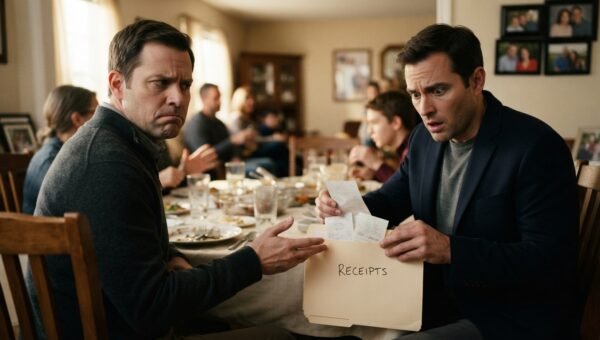
There were no letters from old friends. There were no business documents or tax forms. Instead, I found a neat, orderly stack of carbon-copy rent receipts, all stamped paid in full, for a one-bedroom apartment in a modern garden-style complex called Oakridge Manor, located just past the industrial park on the west side of the county. The monthly rent was seventeen hundred and fifty dollars. The payments had been drafted automatically every single month for the past eleven months, drawn directly from our joint savings account, masked under a vague ledger code that Arthur had told me was a recurring software subscription for his freelance consulting work.
I stared at the receipts until the numbers blurred together. Seventeen hundred and fifty dollars a month. While I was standing behind the pharmacy counter for twelve hours a day, missing my niece’s wedding and popping ibuprofen for my aching back, Arthur was paying rent on an apartment I had never seen, using the money we had saved for our retirement.
My fingers dug deeper into the envelope. At the bottom was a lease agreement bearing Arthur’s signature, dated the very week he supposedly started his new job. But what made the room spin, what made the breath leave my lungs in a sharp gasp, was the emergency contact line listed at the bottom of the form.
The name written in Arthur’s familiar, sloping handwriting was not a stranger’s name. It was our twenty-four-year-old daughter, Chloe.
PART 2
The revelation hit me like physical trauma. Chloe. My only daughter, the girl I had raised with every ounce of my soul, the one who had spent the last six months telling me on the phone that she was drowning in her master’s thesis work, that she had no time to visit, that her weekends were swallowed whole by library archives and study groups. She hadn’t been buried in books. She had been visiting this secret apartment. Or worse, she had been living there.
I walked out of the UPS store, got back into my car, and sat in the driver’s seat for twenty minutes just staring through the rain-streaked windshield. My mind cycled through a dozen memories. Chloe calling me on Tuesday nights, sounding distracted and distant, cutting our conversations short because her laptop was acting up. Arthur leaving the house on Saturday mornings to run errands that took three hours instead of forty-five minutes. The subtle shift in my husband’s demeanor over the past year, the way he suddenly started wearing cologne to go to the hardware store, the quiet confidence in his eyes that I had foolishly mistaken for the return of his old self-esteem.
They had lied to me. Both of them. The two people in this world I trusted implicitly had built a parallel existence right under my nose, funded by my sweat and financed by our future.
I didn’t go home. I drove straight toward Oakridge Manor. The drive took twenty minutes, and by the time I pulled into the asphalt parking lot of the complex, the rain had slowed to a miserable, heavy mist. Building 4 was tucked away near the woodline at the back of the property. I parked my sedan two rows away, cut the engine, and watched.
For nearly an hour, nothing happened. The windows of apartment 4B on the second floor were dark, the blinds drawn shut against the gloomy afternoon. My hands rested on the steering wheel, cold and stiff. I felt like an intruder in my own life, a ghost spying on a family that looked remarkably like mine, yet belonged to someone else.
Then, a familiar silver sedan pulled into the parking space directly beneath the building’s breezeway. It was Arthur’s car.
My breath caught. I watched as he stepped out into the mist, wearing his good wool coat, holding a brown paper grocery bag in one arm. He looked relaxed, almost buoyant, glancing around the parking lot with an easy casualness before walking briskly toward the stairwell. He didn’t look like a man carrying the crushing weight of financial ruin or marital strain. He looked like a man coming home.
He climbed the concrete stairs and disappeared around the corner toward apartment 4B. A minute later, a light flickered on behind the second-floor blinds.
PART 3
My impulse was to storm up those stairs, kick the door open, and demand answers until the walls shook. But twenty-seven years of marriage and a lifetime of common sense held me back. If I went in screaming, I would give them the advantage. They would manage the narrative, spin some elaborate excuse, and make me look like the unstable, paranoid wife. I needed to know the full extent of what was happening before I blew up the bridge.
I reached into my purse, pulled out my phone, and dialed Chloe’s number. It rang four times before she picked up.
“Mom?” her voice came through the speaker, tight and high-pitched.
“Chloe,” I said, keeping my voice terrifyingly calm, though my heart was hammering against my ribs like a trapped bird. “Where are you?”
There was a long, suffocating pause on the other end of the line. When she spoke again, her voice dropped to a nervous, frantic whisper. “Mom, I’m… I’m at the library. On campus. Why? Is everything okay?”
“Are you sure you’re at the library, Chloe?” I asked, watching the lit window of apartment 4B through my windshield. “Because I’m standing outside Building 4 at Oakridge Manor. And I’m looking at your father’s car parked downstairs.”
The silence on the line was absolute. You could have heard a pin drop. Then, a rustling sound came through the phone, followed by a muffled scuffle, as if someone had tried to grab the device away from her.
“Mom, please,” Chloe whispered, her voice cracking with genuine panic. “Please don’t go up there alone. Just wait. Let me explain—”
Before she could finish the sentence, another voice broke through the speaker, crisp and sharp and entirely unexpected. It wasn’t Arthur’s voice. It was a woman’s voice, cool and steady, coming from somewhere in the background near the phone.
“Who is this?” the woman demanded, her tone dripping with an irritating mixture of authority and cold indifference. “Chloe, hang up the phone right now. Don’t talk to her.”
The blood rushed to my ears, roaring like an oncoming train. It wasn’t just Arthur and Chloe playing out some bizarre secret routine. There was someone else in that apartment. Another woman.
“Who is that?” I screamed into the phone, losing every shred of composure I had left. “Who the hell is in that apartment with my husband and my daughter?”
The line clicked dead. The dial tone buzzed in my ear like an angry wasp.
ENDING
I didn’t wait another second. I threw my car door open, marched across the wet asphalt, and ran up the concrete stairs to apartment 4B. I didn’t bother knocking. I slammed my palm against the wooden door and twisted the handle. To my shock, it wasn’t even locked.
The door swung inward with a heavy thud, hitting the drywall inside with a loud crack.
Arthur was standing in the small, open-plan kitchen, holding a mug of coffee, while Chloe sat frozen on the sofa with her face buried in her hands. Standing by the balcony window was a woman in her late thirties with sharp features and designer glasses, looking at me not with guilt, but with the cool annoyance of an executive whose meeting had been interrupted.
“Grace,” Arthur whispered, the coffee mug slipping from his fingers and shattering against the linoleum, splashing dark liquid across my shoes. “Grace, let me explain. It’s not what you think.”
“Don’t you dare,” I said, my voice dropping into a quiet, icy register that made even the strange woman flinch. I looked from my husband to my daughter, and finally to the stranger in the corner. “You have exactly thirty seconds to tell me why my life savings is paying for an apartment where my husband and my daughter are entertaining a total stranger. And then, Arthur, you can pack every single thing you own into garbage bags, because when I walk out of this door, you are never sleeping under my roof again.”