PART 1
I thought my husband was finally growing a softer heart. When Aunt Clara had her hip replaced back in March, she could barely get down the front porch steps with her walker. She was seventy-six, widowed, and fiercely proud about never being a burden on anybody. Her physical therapy was scheduled for every Thursday morning at nine o’clock at the outpatient clinic on Oak Ridge Road.
The clinic was exactly four miles from her little brick bungalow. If you caught both traffic lights green, it took about eight minutes to pull up to the front entrance.
I had planned to take the morning off from the library each week to drive her myself. Then Greg spoke up at breakfast. He had been laid off from the machine parts warehouse since the previous November, spending his mornings drinking black coffee and staring at classified ads on his tablet. He touched my hand across the laminate kitchen table and said it didn’t make any sense for me to burn through my limited sick leave. He said he had plenty of free time on his hands, and helping Clara would give him a sense of purpose while he looked for a steady job.
I almost cried right there into my cereal bowl. We had been married twenty-two years, and Greg was not a man known for volunteering his time. In the past, whenever my family needed help moving furniture or clearing out gutters, he always found an urgent project in the garage or complained about his bad knee.
Seeing him step up felt like an answered prayer. I kissed the top of his thinning head, handed him the keys to our ten-year-old blue sedan, and told him how grateful I was.
For the first four weeks, everything seemed completely normal. Every Thursday at eight-thirty sharp, Greg would finish his toast, put on his jacket, and head out the door. He was always back by eleven. He told me the therapy sessions were grueling for Clara, but she was working hard on the parallel bars and doing her leg lifts without complaining.
By May, however, little things started to feel slightly off. Whenever Greg came back through the mudroom door on Thursdays, he smelled faintly of cinnamon rolls and diner coffee instead of the rubbing alcohol and peppermint lotion they used at the clinic. He started being unusually protective of his leather jacket, hanging it in the back of the hallway closet immediately instead of tossing it over the back of the kitchen chair like he had done for twenty years.
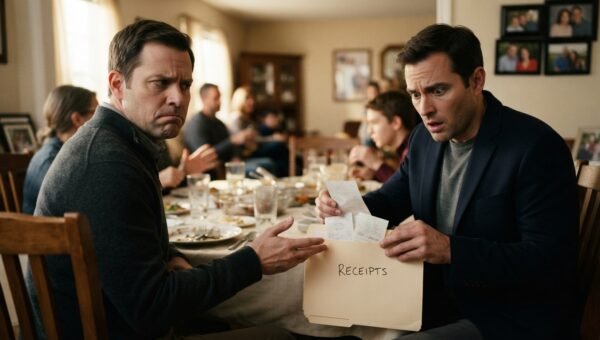
Then came the white envelopes.
The first time I noticed one was on a Friday morning in late May. I went to get the coupon clipper out of the ceramic bowl near the refrigerator, and there was a plain white security envelope tucked halfway under the mail stack. In Clara’s shaky, looping cursive across the front, it said, “For the road and gas, with love.”
When Greg came in from checking the oil in the car, I held it up with a small laugh. “Clara gave you this?” I asked. “Greg, Oak Ridge Clinic is eight minutes away. A gallon of gas lasts two weeks back and forth. You shouldn’t be letting her pay you for giving her a lift.”
Greg took the envelope out of my fingers faster than he usually moved for anything. His face went flat, the way it always did when he felt criticized. “It’s just twenty bucks, Brenda,” he said, shoving it deep into his front jeans pocket. “You know how stubborn she is about taking favors from folks.
If I tell her no, she gets all flustered and feels like charity. Let the old woman have her dignity. I use it to buy her a hot chocolate at the drive-through on the way home.”
I accepted that explanation because it sounded just like Aunt Clara. She was the kind of woman who would force a ten-dollar bill into the hand of the neighbor kid for shoveling two feet of her walkway, refusing to close her front door until he took it.
A week later, I saw another envelope sitting on the dash of the car when I drove it to the grocery store. This one was thicker. The flap was sealed tight with clear tape, and the handwriting was the same: “For the road.” I left it alone, but a cold knot started forming in my stomach.
Two days ago, I decided to go over to Clara’s house on a Tuesday evening to drop off a dish of chicken pot pie and check on her freezer. Clara was sitting in her favorite floral armchair by the bay window, her walker parked neatly beside her, working on a word-search puzzle. Her living room smelled of lavender and lemon polish.
“How was your session with the therapist last week, Aunt Clara?” I asked, setting the warm glass dish down on her kitchen counter.
“Oh, it’s coming along, Brenda,” she said, looking up over the rims of her reading glasses. “The girl with the red hair has me walking up those little wooden practice stairs now. But it sure wears me down. Greg is so patient with me, waiting in the lobby with his phone.”
I sat on the edge of the footstool near her chair. “Clara, I saw the envelope on the counter last week. And the one in the car. You don’t need to give Greg money every single Thursday. We’re family. Gas is barely four dollars a gallon, and the clinic is right down the avenue. It embarrasses me to think you’re paying him to drive you ten minutes.”
Clara stopped her pen in the middle of a circle. She pulled off her glasses, letting them hang on the beaded chain around her neck, and looked at me with genuine bewilderment in her pale blue eyes.
“Paying him for gas?” she asked, her voice cracking slightly. “Brenda, what on earth are you talking about? The envelopes aren’t for gas. Those are for your new house.”
I froze. The room was dead quiet except for the ticking of the pendulum clock on the wall.
“Our new house?” I whispered.
Clara gave me a tender, knowing smile and reached out to pat my knee with a dry, spotted hand. “You don’t have to keep it a secret from me anymore, sweetheart. Greg sat right at that table three months ago and laid it all out. He told me you two found that lovely place out past the county line. The one with the wrap-around porch and the downstairs mother-in-law suite. He said the bank needed an extra private down payment before the commercial loan could clear, and you were too proud to ask me for help.”
The blood rushed out of my face so fast that my ears started ringing.
“He said what?” I managed to say.
“He said you cried in bed every night because you wanted to bring me out of this big empty house to live with you where you could keep an eye on me,” Clara continued softly, her eyes shining with warmth. “He told me every thousand dollars I put in that envelope went straight into the builder’s escrow account in both your names. I’ve given him four envelopes so far, Brenda. Twelve thousand dollars from my money market account. He told me we were only one payment away from getting the keys.”
PART 2
I stood by the bed for five full minutes, staring at Brenda’s signature until the ink seemed to bleed into the paper.
David had died twenty-six months ago. He was Greg’s only brother, four years younger, and when he died, Brenda had fallen apart. She was thirty-nine, left with a small house in the neighboring town and an eleven-year-old son named Toby. For the first six months, our whole family rallied around her. Greg had stepped up to help with Toby, fixing their gutters, mowing her lawn, taking Toby to minor league baseball games. I had encouraged it. I had baked casseroles, packed school supplies, and told Greg repeatedly that God would bless him for taking care of his brother’s widow.
Now, looking at this contract, every memory from the past year shifted into something ugly and calculated.
I flipped to the second document in the folder. It was a certified cashier’s check receipt from our local regional bank, dated three weeks prior. Amount: $35,000. Underneath that was a bank printout showing a newly opened joint checking account under the names Gregory Miller and Brenda Miller.
I looked at the deposit history. There were seven separate cash deposits, each between $2,000 and $2,500, deposited on Thursday afternoons between two-thirty and four o’clock. Every single one of them matched the Thursdays Greg had driven Evelyn to the clinic.
The remaining fifteen thousand dollars in that account had come from a single transfer out of our home equity line of credit, which Greg had drawn against in late May. I had never received an alert because Greg handled the online banking passwords, and the monthly statements had been switched to paperless billing without my knowledge.
Greg hadn’t just stolen sixteen thousand dollars from an old woman who trusted him. He had mortgaged our own home out from under me to buy a private getaway with his dead brother’s wife.
I heard gravel crunch in the driveway.
Greg was home early.
My heart hammered against my ribs, a loud, frantic thumping in my ears. For a second, I wanted to scream, to run out into the driveway waving the papers in his face. But years of working in the county clerk’s office, dealing with property deeds, fraud filings, and angry citizens, taught me one cold, vital rule: if you show your hand before you hold the cards, you lose.
I carefully folded the purchase agreement and the bank statements, slid them into the bottom of my purse, and snapped the ruined lockbox shut. I threw the metal box back on the top shelf behind the boots, pushed the screwdriver under the bed, grabbed a basket of clean laundry from the hallway, and walked into the living room just as the back door clicked open.
Greg walked in carrying his lunch cooler. He looked completely normal. He had on his faded navy work polo, his hair slightly rumpled from the summer heat, smelling of machine grease and peppermint gum.
“Hey, babe,” he said, setting the cooler on the kitchen counter. “House is quiet. How’s Evelyn’s hip today?”
I kept my back to him, folding a bath towel on the dining table. “The therapist says she’s doing well. She’s walking without the cane around the house.”
“Good, good,” he murmured, opening the fridge to pull out a cold tea. “She’s a tough old bird. I’m glad I can help her out on Thursdays. Makes me feel like I’m doing some good, you know?”
“Yeah,” I said, my voice completely steady. “You’re very generous with your time, Greg.”
He didn’t hear the razor in my voice. He just grunted, took a long drink, and wandered into the living room to turn on the evening news.
That night, I didn’t sleep. I lay on the far edge of our queen-sized bed, listening to him snore, feeling a disgust so heavy it felt like physical poison in the room. At five in the morning, when he got up and left for his early shift, I went straight to work.
I called in sick to the clerk’s office. At eight-thirty, I parked my car two blocks away from Brenda’s street and walked up to her house. Her red sedan was in the driveway. Toby had been sent to a summer day camp at the YMCA, so I knew she would be alone.
I didn’t ring the bell. I knocked firmly three times on the front door.
When Brenda opened it, she was holding a ceramic coffee mug, wearing yoga pants and an oversized cardigan. The moment she saw my face, her casual expression dissolved. Her eyes dropped to the heavy manila envelope clutched in my right hand, and the color drained completely from her lips.
“Laura,” she whispered. “What are you doing here?”
“We need to talk about Greenbrier County,” I said.
Brenda stepped back without a word. She didn’t fight it. She didn’t feign ignorance. She just let the storm door fall shut behind me, walked into her small kitchen, and leaned against the counter, clutching that mug with both hands like a shield.
I laid the purchase agreement and the joint bank statements flat on her kitchen table.
“You and Greg,” I said. “How long?”
Brenda stared at the floor. A tear tracked down her pale cheek, but her voice was tight and defensive when she finally spoke. “It’s not what you think, Laura. It’s not some cheap affair. After David died, Greg was the only one who checked on us. He was the only one who understood what David’s illness did to this family.”
“He’s your husband’s brother, Brenda,” I said, keeping my tone deadly low. “And he is my husband.”
“We wanted a fresh start,” she cried, finally looking up at me. Her eyes were red-rimmed and panicked. “Greg said you two had been roommates for ten years. He said you were waiting for your daughter to finish college before filing for divorce anyway. He said he had an inheritance from an uncle that he was using for the cabin so Toby could grow up near the mountains. He told me the escrow money was his!”
I looked at her, searching for any sign of deception. What I saw instead was a weak, selfish woman who had chosen to believe a comfortable lie because it gave her a man to take care of her bills.
“He didn’t have an inheritance, Brenda,” I said, pointing directly at the bank records. “He stole sixteen thousand dollars from Aunt Evelyn. He told an old woman with a bad hip that he was building an in-law suite for her so she wouldn’t die alone in a nursing home. And the other fifteen thousand? That came from a lien he took out against the house I pay the mortgage on.”
Brenda dropped her coffee mug. It shattered on the linoleum, splashing black coffee across her bare feet. She didn’t even look at the mess.
“What?” she gasped, her hands flying to her mouth. “No. No, Greg wouldn’t do that. He had bank drafts…”
“Those are Evelyn’s savings, Brenda. Every single dollar of the cash deposit came out of Evelyn’s credit union account on Thursday afternoons while she thought he was waiting for her in physical therapy.” I took a step closer to her. “The closing on that cabin is scheduled for next Friday, August fifteenth. If that property closes in your name, you are a co-conspirator to elder financial exploitation and grand larceny. In this state, that’s a Class C felony. You will lose your son, Brenda.”
Brenda collapsed onto the kitchen floor right into the spilled coffee, sobbing hysterically, begging me not to call the police.
PART 3
I didn’t call the police. Not yet.
If I called the police that morning, Greg would be arrested, accounts would be frozen by the state, the cabin purchase would be tied up in litigation for two years, and Evelyn’s sixteen thousand dollars would vanish into legal fees and restitution orders that Greg would never pay back.
I needed Evelyn’s money back in her credit union account before Greg realized I knew anything.
I made Brenda sit at her kitchen table, clean the coffee off her feet, and pull up her email.
The closing package for the cabin was sitting in her inbox from the title company in Greenbrier County. The closing was set for Friday at ten in the morning. The title company was holding the thirty-five thousand dollar earnest money deposit in their escrow account. Under the standard purchase contract, if the buyers failed to secure remaining financing or backed out before the final title sign-off, the earnest money was refundable minus a five-hundred-dollar cancellation fee, provided both buyers signed a mutual termination notice.
“You’re going to sign this,” I told Brenda, setting a pen in front of her. “And then you’re going to call the real estate agent and tell her that you are withdrawing as a buyer immediately due to title fraud.”
“Greg will kill me,” Brenda sobbed.
“Greg is going to be very busy dealing with me,” I said coldly. “Sign it.”
She signed the rescission form with a shaking hand. I scanned it immediately with my phone, emailed it directly to the title officer, and had Brenda call the escrow agent on speakerphone right in front of me to confirm her signature. Within thirty minutes, the title officer confirmed that because one of the primary joint purchasers was alleging unauthorized funds and pulling out, the contract was legally terminated and the thirty-five thousand dollar escrow deposit was being wired back to the originating joint checking account that afternoon.
I left Brenda sitting alone in her kitchen.
I drove straight to our bank. Armed with our marriage certificate, the HELOC loan documents, and my name already on the primary checking account, I sat down with the branch manager. I showed him the fraudulent HELOC draw. Because the home equity line required dual authorization for draws over ten thousand dollars, and Greg had forged my digital signature on the secondary verification form, the bank was legally vulnerable.
By two o’clock that afternoon, when the title company’s wire hit the joint account Greg had opened with Brenda, the bank manager executed an immediate internal offset. The fifteen thousand dollars Greg had stolen from our home equity was swept straight back into our line of credit, closing the balance.
That left twenty thousand dollars sitting in that joint account.
Sixteen thousand of it belonged to Aunt Evelyn.
I had the branch manager issue a certified cashier’s check for $16,000 made payable directly to Evelyn Vance. The remaining four thousand dollars was Greg’s own personal savings from his side jobs, which I left sitting in the account so he couldn’t claim I stole his personal wages.
At three-fifteen, I drove over to Evelyn’s house.
I walked inside, sat down beside her on the sofa, and handed her the cashier’s check.
Then, as gently and clearly as I could, I told her the truth. I told her there was no three-bedroom ranch. There was no in-law suite. Greg had lied to her, used her love for our family, and taken her money for himself.
Evelyn didn’t cry. For a long time, she just stared at the blue cashier’s check in her lap. Her hands trembled slightly, but when she looked up at me, her eyes were completely clear, hardened with an old-fashioned dignity that broke my heart.
“He sat right at my table, Laura,” she whispered. “He ate my lemon bars and looked me right in the eye.”
“I know, Aunt Evelyn,” I said, putting my arms around her narrow shoulders. “I know. But you have every dime back. It’s over.”
We drove together to her credit union, redeposited the sixteen thousand dollars into her high-yield savings account, and I had the teller flag her profile with a mandatory in-person dual signature requirement, naming me as her sole authorized power of attorney.
By four-thirty, every single financial leak had been sealed.
Now, there was only one thing left to do.
I went back to our split-level house. I unlocked the front door, walked down the hall to our bedroom, and pulled three large plastic storage bins out of the basement. I emptied Greg’s closet. I packed every pair of his jeans, every work shirt, his hunting boots, his coats, his watch collection, and every single photograph of him from the mantle and the hallway walls.
I stacked the bins neatly on the front porch right next to the front door.
Then I sat down at our kitchen table, laid the original cabin purchase agreement, the fraudulent HELOC draw with my forged signature, Brenda’s signed rescission form, and the receipt for Evelyn’s restored $16,000 savings right in the center of the wood.
At five-fifteen, Greg’s truck pulled into the driveway.
ENDING
I watched through the front window as he got out of his truck. He walked up the front walkway, stopped dead in his tracks when he saw the plastic storage bins stacked on the porch, and frowned. He tried the front doorknob. It was locked.
He pulled out his house key, unlocked the deadbolt, and stepped into the foyer.
“Laura?” he called out, his voice annoyed and slightly bewildered. “What the hell is all my gear doing on the porch? What’s going on?”
“Sit down, Greg,” I said from the kitchen table.
He walked into the dining area, dropping his lunch cooler on the floor. His eyes darted to the table, and the moment he saw the legal papers laid out in a neat, chronological row, his face went completely gray. The arrogant, easygoing posture he had carried for twenty-two years vanished in a fraction of a second.
“What is this?” he stammered, pointing a finger at the papers.
“That’s the cabin in Greenbrier County,” I said, my voice dead, flat, and completely devoid of emotion. “That’s Brenda’s signature pulling out of the purchase. That’s the receipt showing the fifteen thousand dollars you forged my name for has been paid back to our equity line. And that last receipt is Aunt Evelyn’s sixteen thousand dollars, which is safely back in her savings account.”
Greg took a half-step back, his chest heaving. “Laura… listen to me. You don’t understand what happened. Brenda was desperate. She was losing her house. I was just trying to help her invest…”
“Stop talking, Greg,” I said.
I didn’t raise my voice. I didn’t cry. The time for tears had passed hours ago on Brenda’s kitchen floor.
“You used an old woman’s fear of ending up in a nursing home to fund your secret life with your brother’s widow. You looked Evelyn in the face every Thursday afternoon, took thousands of dollars in envelopes, and then came home and ate dinner at this table like an honest man.”
“It wasn’t an affair!” he yelled, his voice cracking into panic. “We were just planning… we were going to tell you! We were trying to build something for Toby!”
“I don’t care about Brenda,” I said. “And I don’t care about what you were building. Here is what is going to happen right now.”
I pulled a single sheet of paper from beneath the receipts. It was an initial marital separation agreement, drawn up two hours ago with a family law attorney I had called from the bank parking lot.
“You are going to take your truck and those three bins on the porch, and you are going to leave this house right now,” I told him. “You will sign this agreement relinquishing your claim to the equity in this home in exchange for me not walking into the county prosecutor’s office tomorrow morning with Evelyn’s bank statements, your forged signature on the bank draw, and Brenda’s sworn statement regarding the cabin.”
Greg stared at the paper, then at me. “You wouldn’t do that to me. We’ve been married twenty-two years. You wouldn’t send me to prison.”
“Try me,” I said. “Look at my face right now, Greg, and tell me if you think I’m bluffing. You have five minutes to get in your truck, or the next person you talk to is Sheriff Davis.”
He looked at the papers on the table. He looked at the door. He saw the cold, absolute finality in my eyes, and he knew he had zero leverage.
He didn’t say another word. He didn’t apologize. He didn’t ask about our daughter. He grabbed a pen, scribbled his signature across the bottom of the separation agreement with a trembling hand, turned around, and walked out the door.
I sat at the table and listened to him load the three bins into the bed of his truck. The engine turned over, the tires crunched across the gravel, and the sound faded down the road into silence.
That was six weeks ago.
The divorce is moving through the county court without a fight. Greg moved into a cheap extended-stay motel near his job; from what I hear through mutual acquaintances, Brenda refused to let him stay at her place, terrified that her in-laws would cut her off entirely if they found out what she had been a part of. The cabin in Greenbrier County went back on the market, and the joint account they opened was officially closed by the bank for suspicious activity.
Evelyn is doing well. Her hip is fully healed now, and she doesn’t need physical therapy anymore.
Every Thursday afternoon, I leave work a little early, drive over to her brick ranch, and take her to the grocery store or the greenhouse. We buy her flowers, we pick up fresh sweet corn, and we come back to her kitchen to sit on the back porch with two glasses of iced tea.
Last Thursday, as I was packing up my purse to head home, she tried to slide a crisp twenty-dollar bill into my pocket.
I took her frail, warm hand in mine, folded her fingers back over the bill, and kissed her forehead.
“Keep it, Aunt Evelyn,” I told her with a smile. “Gas is on me.”