PART 1
The hospital room smelled of floor wax and stale coffee, a thin, persistent odor that seemed to cling to the vinyl chairs and the edges of the beige curtains. My father lay in the center of it all, connected to a quiet rhythm of monitors that clicked and beeped with every breath he took. He was seventy-eight years old, his chest rising and falling beneath a thin blue blanket after a triple bypass that had gone longer than the doctors liked.
My mother sat in the corner, her fingers twisted tightly into the handles of her canvas handbag, watching the steady green line on the screen as if she could pull him back from the edge with her eyes alone.
I stood by the window, looking out over the asphalt parking lot where cars moved like beetles in the late afternoon glare. We had been here since six that morning. The surgery was supposed to be routine, or as routine as heart surgery ever gets for a man who had spent forty years working construction in Ohio before retiring to North Carolina. But complications had kept him under anesthesia an extra three hours, and when the surgeon finally came out to talk to us, his expression was guarded, professional, and entirely noncommittal.
The door to the room creaked open. I didn’t turn around immediately, assuming it was the nurse coming in to check his IV drip or adjust the saline bag.
Then my mother’s breath hitched. It wasn’t a gasp, exactly, but a sharp, sudden intake of air that made me spin around.
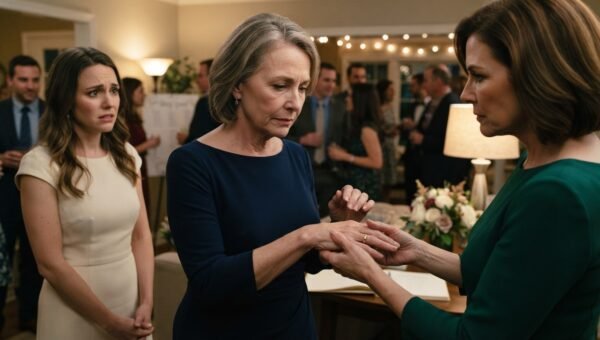
A woman stood just inside the doorway. She was perhaps a few years younger than my mother, maybe in her early seventies, wearing a sensible navy blue raincoat that was unbuttoned at the collar and carrying a small, worn leather purse. Her hair was silver-gray, cut short and neat, and her eyes were fixed entirely on the bed. She didn’t look like a nurse or a social worker. She looked like someone who belonged in a completely different room, in a completely different life.
Before any of us could speak, the woman walked past my mother without a glance, stepped right up to the metal railing of my father’s bed, reached out with a gloved hand, and took my father’s limp, pale hand in hers.
“Tommy,” she murmured. Her voice was low, raspy, and thick with an accent I couldn’t quite place—maybe somewhere from the upper Midwest, or down east from the coast. “Oh, Tommy. They said you weren’t going to make it.”
My mother dropped her plastic cup of ice water. It hit the linoleum floor with a sharp crack, the ice cubes scattering across the gray tiles like broken teeth, while a puddle of water soaked into the hem of her trousers.
“Who are you?” my mother asked. Her voice was ice-cold, stripped of all the fatigue and worry that had hung over her for the last ten hours. She stood up so fast her chair scraped against the floor, a grating sound that made my teeth ache.
The woman turned her head slowly, looking at my mother as if she were just realizing someone else was in the room. She didn’t look guilty or startled. She looked tired, with deep lines carved around her mouth and eyes that held a heavy, accumulated weight.
“I’m Eleanor,” the woman said simply.
“I don’t know any Eleanor,” my mother said, her chin coming up in that stubborn, defensive angle I knew so well.
She had raised three kids on that stubbornness, keeping the household afloat through two recessions and my father’s intermittent layoffs. “And you have no right touching him. Nurse! Security! Get this woman out of here.”
“I have every right,” Eleanor said quietly. She didn’t raise her voice, which somehow made my mother even angrier. “I’ve known Tommy since 1976. Long before any of this.”
She reached into her coat pocket, pulled out a worn, yellowed piece of cardstock, and laid it gently on the edge of the rolling tray next to my father’s medications. It was a ticket stub. The blue ink was faded, but the bold black letters were still legible: CLEVELAND MUNICIPAL STADIUM, JULY 14, 1976.
My mother stared at the date. The color drained from her face so fast her skin took on a grayish, translucent tint, matching the hospital walls.
“He kept it in his wallet,” Eleanor said, her gaze shifting back to my father’s face. “Right behind his driver’s license. Every single day of his life, he carried it. Even after he moved south, even after he married you. I know he did, because I gave it to him when we walked out of those gates together.”
“That’s a lie,” my mother whispered, though her hands were shaking so badly she had to grip the metal frame of the bed to steady herself. “He met me in the fall of seventy-six. We got married in seventy-eight. We built a life. We built a home. He didn’t know anyone else.”
“Ask him,” Eleanor said, nodding toward the bed. “When he wakes up, ask him where he was the summer before the steel mills started laying everyone off. Ask him who was with him when the rain came down so hard the game had to be called in the sixth inning.”
Before either woman could say another word, the heart monitor beside the bed changed its tone. The steady green line spiked into a frantic, jagged wave. The beeping accelerated from a calm, measured pulse into a rapid, high-pitched alarm that echoed off the cinderblock walls.
A nurse burst through the door, followed immediately by an orderly pushing a crash cart.
“Everyone out,” the nurse snapped, her eyes wide as she shoved past Eleanor and my mother. “Right now. Step out into the corridor.”
In the scramble, as the medical staff crowded around the bed and blocked our view, the nurse grabbed my father’s discarded clothes from the plastic bag on the shelf to clear space for the equipment. As she lifted his heavy canvas trousers, a second ticket stub slipped from the coin pocket and fluttered down onto the linoleum, landing right beside the puddle of melted ice.
I bent down automatically and picked it up. It was identical to the one Eleanor had left on the tray—another ticket stub from the exact same Cleveland game in July 1976.
I turned it over to see if there was a seat number or a price stamped on the back. Instead, I found a handwritten note scrawled in faded blue ballpoint ink. It was my mother’s handwriting. I would know those cramped, slanted loops anywhere; she had written out my school lunch menus and grocery lists in that exact hand for thirty years.
There were six words written on the back of that ticket stub, addressed to the stranger standing three feet away from me.
Eleanor saw me looking at it. She reached out, took the ticket from my fingers with surprising gentleness, and read the words aloud in a choked whisper.
“So you knew where they took the baby.”
PART 2
The corridor outside Room 412 smelled of bleach and floor wax. For twenty agonizing minutes, doctors and nurses moved in and out of the room, the heavy door swinging shut before we could catch more than a glimpse of the silver defibrillator paddles and the frantic movement of white coats. My mother sat slumped on the orange vinyl bench against the wall, her hands pressed over her face, her shoulders shaking with dry, silent sobs. I stood a few feet away, holding the two ticket stubs in my hand like a pair of loaded dice, my mind racing through every family story, every holiday dinner, and every quiet Sunday afternoon I thought I understood.
When the attending physician finally stepped out into the hallway, his mask pulled down around his neck, he looked exhausted.
“He’s stable,” the doctor said, wiping a hand across his forehead. “The bypass graft held, but that spike was brought on by acute stress and a sudden spike in blood pressure. His heart is weak right now. He needs absolute quiet. No visitors for the next few hours except immediate family.”
He looked at Eleanor. Eleanor didn’t flinch. She stood tall in her navy raincoat, her hands clasped in front of her purse.
“She’s not family,” my mother said, her voice raspy as she dropped her hands from her face. She looked older than her seventy-five years, the lines around her mouth etched deep with fifty years of history that was suddenly unraveling. “She has no business here. Tell her to leave.”
“I’m not leaving, Helen,” Eleanor said, using my mother’s first name with an unsettling, quiet familiarity. “Not this time. Not after forty-eight years of wondering whether he even made it out of Cleveland alive.”
“You knew her,” I said, looking down at my mother. My voice sounded hollow in the quiet hallway. “Mom, you knew who she was before she even said her name. That handwriting on the ticket… that was yours.”
My mother closed her eyes. She didn’t deny it. She just leaned her head back against the wall, her breath coming in shallow, shuddering gasps.
“It was 1976,” my mother said to the floor, her voice barely above a whisper. “Before I ever met your father at the union hall dance. I was nineteen. I lived in a boarding house three blocks from the stadium. Tommy… Tommy was working the night shift at the foundry and running numbers for his uncle on the weekends. We were… we were young, and we thought we had the whole world figured out until the world figured us out first.”
“You didn’t just ‘figure us out,’ Helen,” Eleanor said, taking a step closer. The anger in her voice was tempered by a deep, hollow sorrow. “You packed a suitcase and vanished while I was still bleeding in the charity ward of St. Jude’s. You told Tommy the baby didn’t survive. You told him there was nothing left for either of us.”
The hospital hallway seemed to narrow. A dietary aide pushing a cart of lukewarm gelatin cups slowed down as she passed us, sensing the tension, before hurrying away around the corner.
“I was nineteen and terrified,” my mother snapped, her voice cracking with a mix of shame and defensive fury. “My father would have thrown me out on the street. In seventy-six, an unwed mother in a Catholic neighborhood in Cleveland wasn’t just a scandal—it was a disaster. My aunt arranged for a family in Dayton to take the baby the night she was born. Everything was legal. Everything was sealed. I told Tommy it died because if I had told him the truth—that we gave her away—he would have torn the city apart trying to find her, and we would have ended up in prison or worse.”
“And you never told him?” Eleanor asked, her eyes flashing with a sudden, sharp heat. “Not once in all these decades? Not when you bought your first house? Not when you raised your two boys? You let him carry that grief like a stone in his pocket for fifty years?”
“He forgot!” my mother cried, tears finally spilling over her lashes and cutting tracks through the powder on her cheeks. “Or he tried to. We built a life, Eleanor. A real life. We paid off our mortgage, we sent our kids to college, we buried my mother and his father. If I had told him, it would have destroyed everything we built. Some secrets are meant to stay buried because digging them up only kills the people who are left.”
I looked from my mother to Eleanor, the weight of the realization pressing down on my chest like a physical weight. The two ticket stubs in my hand weren’t just mementos of a baseball game. They were the matching halves of a fracture that had shaped every single year of my family’s existence.
PART 3
Two hours later, the nurse allowed us back into the room one at a time. My father was still asleep, his breathing slower and more regular now, the rhythmic beep of the monitor filling the small space with a soothing cadence.
My mother went in first. She spent ten minutes alone with him behind the closed curtain. When she came out, her eyes were red-rimmed and dry, her expression set in a hard, unyielding mask of resignation. She didn’t look at Eleanor as she walked past her toward the exit.
“He’s awake,” my mother said to me, her voice flat. “He wants to see both of us.”
I pushed open the door and stepped inside, Eleanor following closely behind me.
My father looked small in the hospital bed, the heavy blankets pulled up to his chest, his gray hair standing up in tufts around his ears. When he saw Eleanor standing in the doorway behind me, his eyes widened. For a second, he looked like a young man again—the twenty-two-year-old steelworker from the bleachers at Cleveland Municipal Stadium.
“El?” he whispered. His voice was like dry leaves scraping across concrete. “Is that… is that really you?”
Eleanor walked slowly to the side of the bed. She didn’t touch him this time. She just looked down at him, her hands trembling slightly at her sides.
“It’s me, Tommy,” she said softly. “I’m here.”
“Helen told me…” He stopped, swallowing hard as a monitor blipped a warning. He looked toward the door where my mother had been standing. “Helen told me forty years ago that our little girl didn’t make it through the night. She said the nurse gave her the death certificate.”
“Helen lied, Dad,” I said quietly, stepping up to the other side of the bed and laying the two ticket stubs on the blanket right in front of him. “She gave the baby up for adoption in Dayton. She didn’t want you to know because she was scared.”
My father stared at the ticket stubs. His hand, shaking and mottled with age spots, reached out slowly and traced the faded blue ink of the ticket Eleanor had carried in her wallet for half a century. Then his fingers brushed against the second ticket—the one with my mother’s handwriting on the back.
“She knew,” my father whispered. A single tear cut through the wrinkles at the corner of his eye and rolled down into the gray stubble of his cheek. “All these years… I kept this ticket because it was the last day we were truly happy before everything went dark. And she had the other one all along.”
“She didn’t know I kept mine, Tommy,” Eleanor said gently, her voice cracking as she finally reached out and rested her hand over his knuckles. “I’ve spent my whole life wondering if you even remembered that afternoon. I never married. I never had another child. I just… I kept the ticket.”
The room grew very quiet. The heart monitor beeped on, steady and calm, marking out the seconds of a life that was suddenly being rewritten in the sterile light of a hospital intensive care unit.
“Where is she?” my father asked, looking up at Eleanor with a desperate, pleading urgency that tore at my chest. “Our daughter. Do you… do you know where she went?”
Eleanor pulled a folded, yellowed adoption agency receipt from her leather purse—a document she must have carried with her for decades, waiting for a moment that might never come.
“Her name is Sarah,” Eleanor said, her voice steady now, filled with a quiet strength that seemed to fill the entire room. “She lives in Columbus. She’s a schoolteacher. She has two kids of her own.”
She looked past my father at me, her eyes shining with unshed tears.
“And she’s been looking for her birth parents for the last ten years.”
ENDING
Three weeks later, the leaves outside our house in North Carolina began to turn the dry, rust-brown color of an Ohio autumn. My father was home from the hospital, sitting in his favorite armchair by the living room window with a woolen blanket over his knees and an oxygen tank hissing quietly in the corner.
My mother didn’t move out, but the dynamic in the house had shifted into a fragile, silent truce. They lived like two strangers sharing a boarding house, passing each other in the hallway with polite nods and murmured questions about medication schedules and doctor appointments. The fifty-year foundation of our family had cracked down the middle, and neither of them knew how to patch the concrete.
Last Saturday, a silver sedan pulled into our driveway.
I was standing on the front porch with a mug of coffee when the passenger door opened and a woman in her late forties stepped out. She had my father’s nose, my mother’s high cheekbones, and a smile that belonged entirely to someone who had spent her whole life wondering where she came from.
Her name was Sarah.
When my father saw her walking up the concrete path toward the porch, he didn’t wait for me to help him up. He pushed himself out of his armchair, grabbed his aluminum walker, and made it all the way to the screen door before his knees gave out and I had to catch him by the elbow.
Eleanor was right behind Sarah, carrying a small canvas bag of old photographs and ticket stubs from a summer in Cleveland that had never truly ended.
My mother watched from the kitchen window, standing behind the sheer white curtains with a cup of black coffee growing cold in her hands. She didn’t come out to the porch, and none of us asked her to. Some wounds are too deep for a single afternoon to heal, and some truths take longer than a lifetime to forgive.
But as my father reached out a trembling hand and touched his daughter’s face for the very first time, I knew the story wasn’t over. It was just finally beginning in the light.